

Moving day anxiety is real. You tape up the last box, the truck arrives, and suddenly you realize nothing is labeled, your laptop charger is buried under winter coats, and your kid's school records are somewhere in a mystery box. This kind of chaos is preventable. A clear, step-by-step DIY packing process gives California homeowners control over the move before it controls them. This guide walks you through every stage, from gathering supplies to doing a final walkthrough, so you arrive at your new home ready to settle in, not dig out.
Table of Contents
- Gather your packing materials: What you need before you start
- Step-by-step: The DIY packing process explained
- Packing special items: Electronics, valuables, and fragile goods
- Troubleshooting common packing mistakes and verifying your work
- What most guides miss about efficient DIY packing
- Next steps: Get expert help or explore more packing tips
- Frequently asked questions
Key Takeaways
| Point | Details |
|---|---|
| Start with smart prep | Gather quality supplies and color-coded labels to make packing easier and unpacking more organized. |
| Follow proven steps | Pack non-essential items first, tackle daily-use rooms last, and always secure valuables with care. |
| Avoid common mistakes | Never overpack boxes, label every side, and double-check fragile items for safe travel. |
| Adapt to your schedule | Customize your packing sequence to fit your timeline, prioritizing out-of-sight areas when rushed. |
Gather your packing materials: What you need before you start
Before you pack a single item, you need the right tools on hand. Showing up to pack without proper supplies is like starting a road trip without gas. You will waste time, make extra trips to the store, and end up improvising with materials that do not protect your belongings.
Here is a breakdown of the essential supplies every California homeowner needs before packing begins:
| Supply | Purpose | Sourcing tip |
|---|---|---|
| Small, medium, and large boxes | Different items require different box sizes | Buy bundles from home improvement stores or ask grocery stores for free boxes |
| Packing tape and tape gun | Seals boxes securely | Buy a tape gun to save time vs. wrestling with a roll |
| Permanent markers | Labeling box contents and destination room | Buy at least 3 so you are never hunting for one |
| Bubble wrap or packing paper | Cushions fragile items | Stock up; you will use more than you expect |
| Stretch wrap or plastic film | Bundles furniture, keeps drawers closed | Available at moving supply retailers |
| Zip-lock bags | Organizes small parts, screws, and cables | Keep a box of assorted sizes nearby at all times |
| Mattress and furniture covers | Prevents damage during transport | Often sold in moving supply kits |
Key tips for saving money and time on materials:
- Check local Facebook Marketplace groups for free or cheap used boxes from recent movers
- Save newspapers for wrapping non-delicate items instead of buying packing paper
- Use your own linens, towels, and clothing as padding inside boxes
- Buy tape in bulk packs, you will use far more than one roll
- Label boxes on at least two sides so you can read them when stacked
One critical rule backed by packing best practices: pack heavy items in small boxes with heavier items on the bottom, fill empty space to prevent shifting, and seal and label on multiple sides. This keeps boxes structurally sound and movers from accidentally flipping fragile contents.
Review a complete packing supplies checklist before your first packing session to make sure nothing is missing.
Pro Tip: Assign a specific color of tape or a colored marker to each room. For example, blue for the bedroom, red for the kitchen. When boxes arrive at your new home, movers can place them in the correct room at a glance without reading a single label.
Step-by-step: The DIY packing process explained
With your supplies ready, it is time to work through the packing process in a logical sequence. Random packing leads to chaos. A clear order keeps your daily life running until the last possible moment and ensures nothing critical gets buried.
The standard packing sequence:
- Declutter first. Before one item goes into a box, decide what to keep, donate, or throw away. Moving unwanted items wastes money on boxes, tape, and truck space.
- Pack storage areas. Start with attic, garage, and basement items. These areas hold things you rarely use and are the safest to pack early without disrupting your routine.
- Move to guest rooms and seasonal items. Guest bedrooms, holiday decorations, and off-season clothes can be packed weeks in advance.
- Pack books, decor, and non-essential shelves. These items look important but are rarely used daily. Get them boxed and stacked early.
- Tackle main living areas. Pack artwork, extra linens, and anything in living room storage. Leave furniture until moving day.
- Pack the kitchen, except daily-use items. Box up infrequently used appliances, extra dishes, and pantry staples. Leave out a basic set of dishes, cookware, and utensils for the final days.
- Pack bedrooms last, except essentials. Leave out enough clothes for the final week. Pack the rest.
- Final day: pack daily-use items. Kitchen essentials, toiletries, chargers, and any remaining clothes go into clearly labeled "open first" boxes.
Comparison: Traditional vs. time-crunched packing approach
| Factor | Traditional approach (2+ weeks) | Time-crunched approach (3 days) |
|---|---|---|
| Starting point | Storage and rarely used rooms | Storage and out-of-sight areas first |
| Daily-use items | Packed a few days before move | Packed on the very last day |
| Room order | Room by room, methodical | Prioritize by frequency of use |
| Stress level | Lower with time | Higher but manageable with focus |
| Risk of mistakes | Low with planning | Higher without a checklist |
If you are working with a tight timeline, the 3-day packing approach recommends starting with out-of-sight storage, garage, and attic areas and postponing kitchen and bathroom daily-use items until the final day. This keeps your home functional for as long as possible.
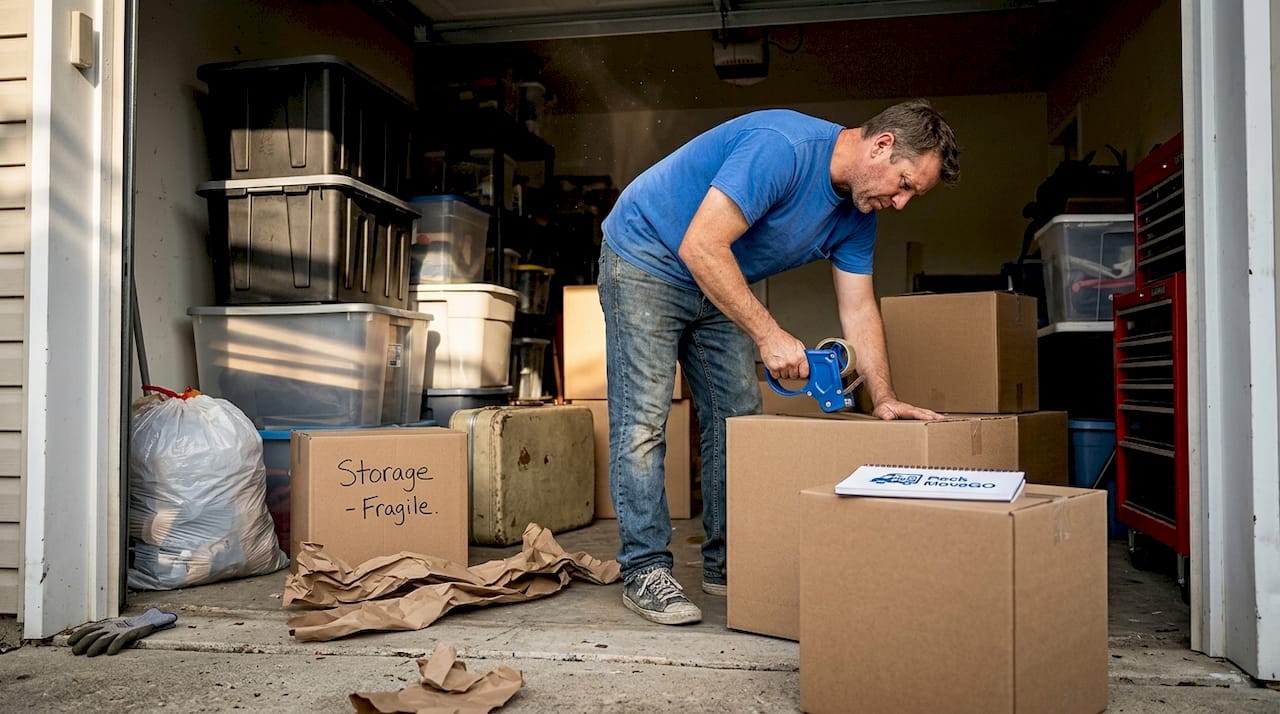
For more detailed guidance specific to your situation, browse packing tips for California moves and smart packing strategies based on home size and move distance.
Pro Tip: Start packing the room you use least first. Most people delay starting because they do not want their home to feel chaotic. Packing a guest room or storage closet first gives you momentum without any lifestyle disruption.
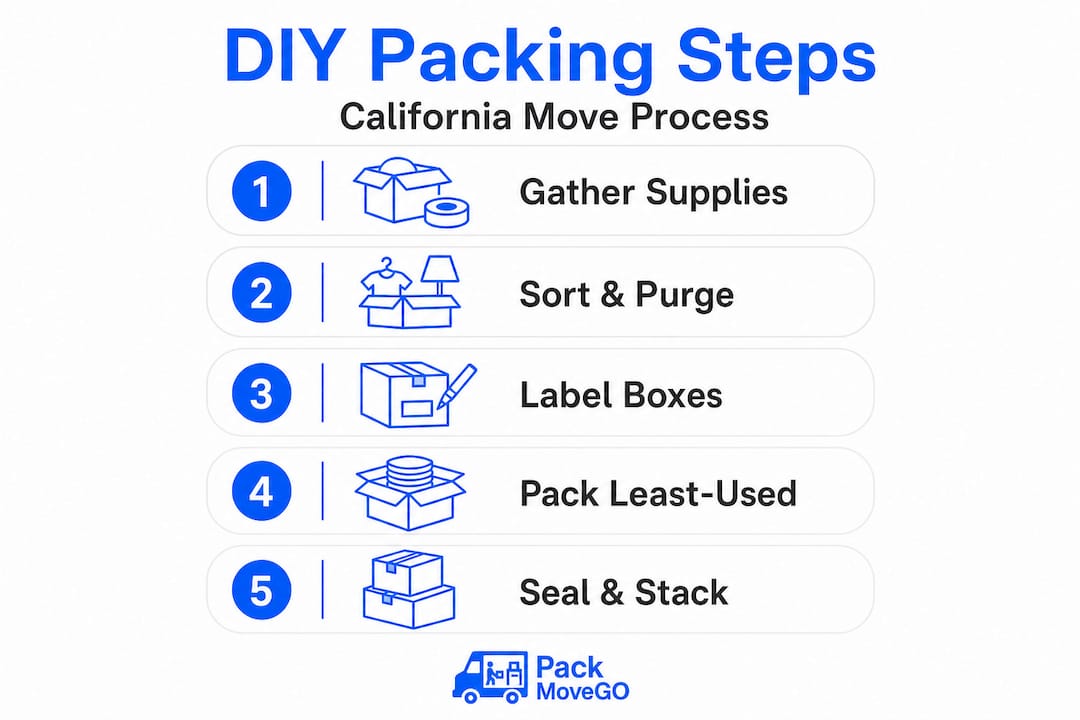
A safety note worth repeating: Overpacked boxes break. A box loaded past its weight limit will fail on a ramp or during a stack. Always lift and test each box before sealing. If you cannot comfortably lift it, remove items and distribute the weight across two boxes.
Packing special items: Electronics, valuables, and fragile goods
Beyond basic household items, you will need to treat electronics and valuables with extra care. These are the items most likely to be damaged or lost during a move, and they are often the most expensive to replace.
Electronics packing checklist:
- Remove batteries from all remotes, clocks, and small devices before packing to prevent corrosion
- Use original manufacturer boxes when available since they are shaped specifically for each device
- Wrap screens in anti-static bubble wrap, never newspaper, which can scratch surfaces
- Coil cables loosely and store them in labeled zip-lock bags attached to or placed inside the corresponding device box
- Take a photo of the back of your TV, computer, and home theater system before disconnecting cables so you can reassemble without guessing
- Label each cable bag with the device name using a marker so setup at the new home is fast
For detailed guidance on packing electronics safely without damage, especially for home office setups, a step-by-step approach prevents the most common reassembly headaches.
When it comes to valuables and important papers, the rule is simple. Do not put them on the truck. As noted in this moving checklist, valuable small items and important papers should be treated as special-handling items, kept separate, and carried personally during the move.
Important: Mishandling fragile or high-value items during a move is one of the leading causes of both financial loss and post-move frustration. Jewelry, passports, birth certificates, medical records, and irreplaceable personal items should travel with you in a bag or box that never leaves your sight. No moving truck is worth the risk.
This applies to prescription medications, legal documents, and any items with sentimental value that cannot be replaced. Pack them in a single dedicated bag and keep it in your personal vehicle.
Pro Tip: Before the move, photograph the serial numbers of all major electronics and store those photos in a cloud service. If something is lost or damaged in transit, you will have documentation for insurance claims.
Troubleshooting common packing mistakes and verifying your work
After packing, take time to check and fix common errors before moving day arrives. Most moving mishaps are not random accidents. They are predictable problems that a short review process can catch in advance.
The most common packing mistakes California homeowners make:
- Overpacking boxes. Heavy books, tools, or kitchen appliances piled into large boxes make them impossible to lift safely and prone to failure. Always use small boxes for dense, heavy items.
- Forgetting to label. Unlabeled boxes become guesswork at the new home. Label every box with both the contents and the destination room. Based on core packing guidelines, labeling on multiple sides makes boxes easy to identify regardless of how they are stacked.
- Not securing fragile items. Fragile items placed loosely in boxes will shift and break. Wrap each piece individually, then fill gaps with crumpled paper or clothing to eliminate movement.
- Mixing rooms in one box. Packing items from the kitchen and the bedroom together makes unpacking twice as hard. One room per box is a firm rule.
- Forgetting to pack an "open first" box. Without essentials accessible on day one, your first night in the new home will be spent tearing through boxes for a phone charger or a bar of soap.
How to verify your packed boxes before loading:
- The shake test. Pick up each box and gently shake it. If you hear or feel items shifting, open it and add more padding.
- The lift test. If a box is too heavy to carry comfortably, it is too heavy. Distribute weight into a second box.
- Label check. Walk through every packed box and confirm it has the room name, a brief contents description, and labels on at least two sides.
- Final walkthrough. Before the truck arrives, walk through every room, closet, cabinet, and drawer. Check under beds, in medicine cabinets, and inside appliances like the oven and refrigerator.
Understanding the difference between packing vs. loading helps you approach each phase with the right focus. And if you are considering storing items during your move, verifying what goes into storage versus the truck needs its own checklist so nothing ends up in the wrong place.
A statistic worth noting: A poorly packed box with empty space or excess weight is significantly more likely to collapse or burst during transit. Professional movers consistently report that box failure during loading is almost always tied to either overpacking or under-filling, both of which are preventable with a few minutes of quality checking.
What most guides miss about efficient DIY packing
Having covered the practical steps and troubleshooting tips, here is an honest perspective you will not find in most how-to guides.
Most packing guides tell you to go room by room. Start in the bedroom, finish in the kitchen. It is tidy advice, but it does not work for every household. A family with young kids cannot pack the playroom three weeks out. A remote worker cannot pack their office two weeks before the move. Advising everyone to follow the same room-by-room sequence ignores how people actually live.
The smarter approach is to sequence your packing around your lifestyle, not the floor plan. Ask yourself: what do I actually use every day? What can disappear for two weeks without anyone noticing? Pack based on those answers. The guest room can go first regardless of where it sits in the house. The junk drawer full of old cables can go before the living room. Sequence by frequency of use, not by location.
There is also a psychological benefit to this approach. When you pack the right things first, your home still feels like home for longer. That matters for families, for children, and for your own stress levels during an already demanding time. A home that still functions normally for two weeks keeps everyone calmer heading into moving day.
Rushed moves especially benefit from this thinking. When you only have a few days, you cannot afford to pack things you will immediately need. Prioritize what is invisible to daily life and leave everything else until the last 24 hours.
Every move is different. Customize your steps based on how to prepare for movers in California and your specific timeline, not just a generic checklist.
Next steps: Get expert help or explore more packing tips
If you are ready to continue your DIY move or want professional support, here is how PackMoveGo can help.
DIY packing is absolutely manageable with the right plan, and this guide gives you the foundation. But sometimes you need a team behind you, whether for peace of mind, a tight timeline, or a complex move with fragile or oversized items.
PackMoveGo serves California homeowners with licensed, insured moving services built around your schedule and needs. From full-service packing support to transportation and storage solutions, you can access everything in one place. Browse the complete moving services overview to find the right level of support for your move. For actionable guidance you can use right now, explore the full library of moving tips and tricks from the PackMoveGo team. Get a free quote today and take the uncertainty out of your next California move.
Frequently asked questions
What's the best way to pack heavy items for a move?
Use small sturdy boxes, place heavier items on the bottom, and fill empty spaces with padding before sealing. Following solid box packing standards, secure and label the box on multiple sides so it stays intact through loading and transport.
How should I handle valuables and important paperwork during a move?
Keep valuables and important papers in a separate bag that travels with you personally, never on the moving truck. According to this moving house checklist, treating these as special-handling items protects you from loss or damage during transit.
What's the most efficient packing sequence if I'm short on time?
Start with storage, garage, and out-of-sight areas, then save kitchen and bathroom daily-use items for the very last day. This 3-day packing method keeps your home functional for as long as possible while still making steady progress.
How do I avoid common packing mistakes?
Do not overpack boxes, always label at least two sides of every box, and wrap each fragile item individually with padding. These basics, drawn from reliable packing advice, prevent the most common and costly moving day problems.