

Moving in California is one of the most complex residential tasks you can take on. Between sky-high costs, strict tenant laws, congested freeways, and tight parking in cities like San Francisco and Los Angeles, even a short local move can spiral into a stressful and expensive ordeal. Whether you own your home or rent an apartment, the difference between a smooth move and a chaotic one almost always comes down to planning, preparation, and knowing California-specific rules. This article gives you evidence-backed, practical steps to stay organized, cut costs, and avoid the last-minute panic that derails so many California moves.
Table of Contents
- Start early: Planning and checklist essentials
- Declutter to cut costs and stress
- Packing smart: Labeling, color-coding, and protecting valuables
- Essentials and first-night box: What you can't forget
- Move-out logistics: California-specific rules for renters and homeowners
- What most guides miss about moving in California
- How PackMoveGo makes moving in California easier
- Frequently asked questions
Key Takeaways
| Point | Details |
|---|---|
| Plan early | Starting 8-12 weeks ahead and using a checklist prevents last-minute problems and helps secure the right moving services. |
| Declutter for savings | Reducing your load can save thousands on moving costs and make packing easier. |
| Pack smart | Label, color-code, and carefully pack fragile items to avoid breakage and simplify unpacking. |
| Prepare essentials | A first-night box with must-haves keeps you comfortable and avoids chaos during the move. |
| Follow California rules | Renters should document their apartment's condition; homeowners must handle utilities and permits well in advance. |
Start early: Planning and checklist essentials
The single biggest mistake California movers make is starting too late. Once you know your move date, you need to act immediately. Start planning 8-12 weeks in advance with a detailed checklist, budget, and timeline. That runway gives you time to compare moving companies, gather packing supplies, and handle the bureaucratic steps that California throws at you.
Here is a practical timeline to follow:
- 8-10 weeks out: Set your moving date, research and book moving companies or truck rentals, and create your full task checklist.
- 6-8 weeks out: Begin decluttering, gather your packing supplies, and notify your landlord or list your home for sale.
- 4-6 weeks out: Start packing non-essential items, update your address with the post office, and transfer school or medical records.
- 2-4 weeks out: Confirm moving company details, pack most belongings, and handle utility transfers.
- 1-2 weeks out: Pack your essentials box, confirm parking permits, and do a final walkthrough of both properties.
- Moving day: Keep important documents with you, supervise loading, and do a final sweep before leaving.
California adds layers of complexity that other states do not. Renters must give 30 to 60 days written notice depending on how long they have lived in the unit. Homeowners need to coordinate utility disconnections and reconnections across multiple providers, including electricity, gas, water, and internet. In dense urban areas, you may need a parking permit or loading zone reservation, which requires submitting paperwork to your local city department days in advance.
Pro Tip: In major California cities like San Francisco, Los Angeles, and San Diego, moving company slots fill up fast on weekends and at the start or end of each month. Book your movers or truck at least 6-8 weeks ahead. You can explore a packing supplies checklist to get a head start on what you will need.
With your move scheduled, the next step is reducing what you need to pack and transport.
Declutter to cut costs and stress
Decluttering is not just a lifestyle choice. It is a financial strategy. Before you pack a single box, go through every room and sort belongings into keep, donate, sell, or recycle to reduce volume, costs, and stress. The less you move, the less you pay.
Here is why the numbers matter. Decluttering can save $2,500-$3,750 on a typical 3-bedroom move by reducing 2,000-3,000 pounds of total weight. Most professional movers price by weight and distance. Every item you leave behind is money back in your pocket.
Practical decluttering steps:
- Go room by room rather than tackling the whole house at once
- Separate items into four clear bins or areas: keep, donate, sell, and recycle
- Use Facebook Marketplace or Craigslist to sell furniture locally and generate cash before your move
- Contact local organizations like Habitat for Humanity ReStore or Goodwill for furniture pickups
- Recycle electronics through California's e-waste program rather than dumping them
Here is a quick look at potential savings from decluttering:
| Item removed | Approximate weight | Estimated savings |
|---|---|---|
| Old sofa | 150-300 lbs | $75-$150 |
| Dresser | 100-200 lbs | $50-$100 |
| Box of books | 30-50 lbs | $15-$25 |
| Exercise equipment | 100-500 lbs | $50-$250 |
| Kitchen appliances (unused) | 50-150 lbs | $25-$75 |
Pro Tip: Donate bulky furniture locally rather than hauling it to a transfer station. California landfill fees can add up quickly, and many donation centers offer free pickup for large items, which saves you both time and disposal costs. You can find more organizational strategies to help you structure this process efficiently.
Once you have pared down your belongings, efficient packing is your next priority.
Packing smart: Labeling, color-coding, and protecting valuables
Packing is where most moves break down. Boxes end up in the wrong rooms, fragile items get broken, and finding the coffee maker on day one becomes a 20-minute ordeal. Solid packing technique fixes all of this.
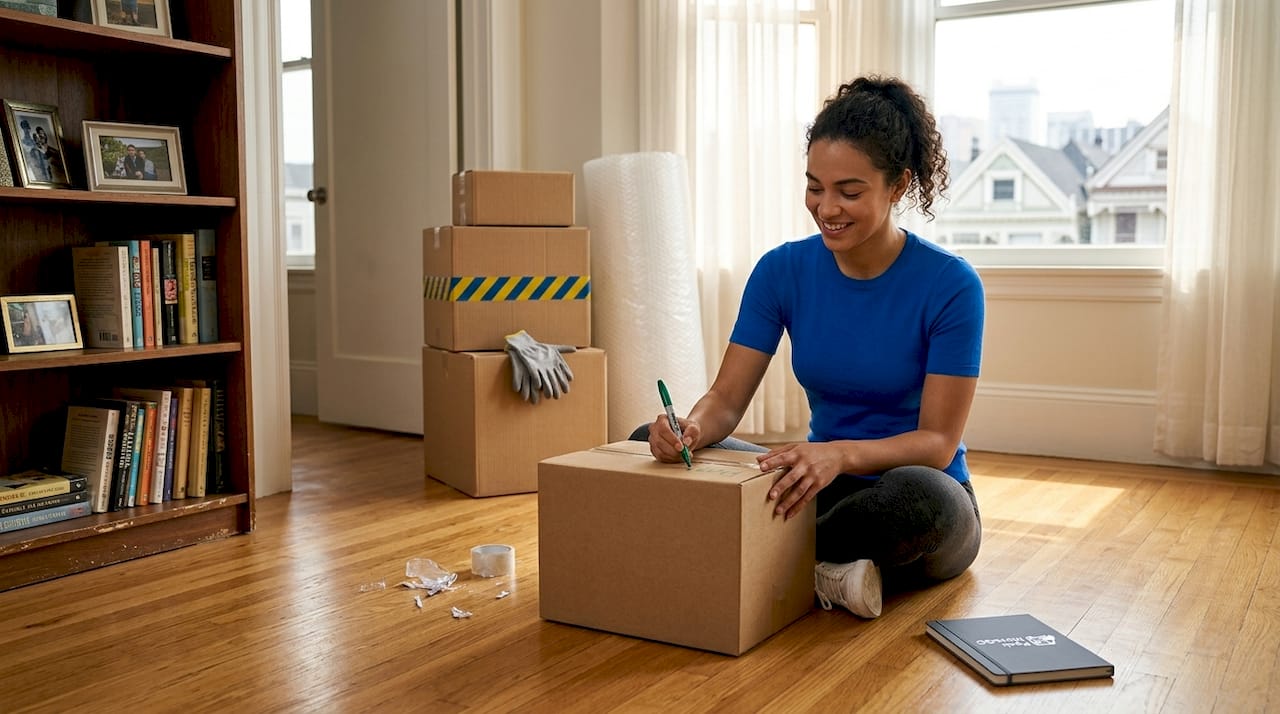
Start with proper packing techniques: label boxes by room, category, and color-code, pack fragile items vertically, and photograph cords before disconnecting electronics. These steps take a few extra minutes upfront but save hours of frustration during unpacking.
Key packing practices to follow:
- Assign a color to each room (blue for kitchen, green for bedroom, etc.) and put colored tape on every box from that room
- Write the room name and a brief content description on the top and two sides of every box
- For dishes, pack plates on their edge vertically with padding between each one — this dramatically reduces breakage
- Photograph the back of your TV stand and entertainment center before unplugging anything so you know exactly how to reconnect everything
- Mark any box containing fragile items on at least three sides so movers can see it from any angle
Here is a comparison of two common labeling systems:
| Feature | Color-coding system | Label-only system |
|---|---|---|
| Speed of unpacking | Faster — visual at a glance | Slower — requires reading each box |
| Works for movers | Yes — easy instructions | Sometimes — if writing is clear |
| Cost | Slight extra (colored tape) | Minimal |
| Best for | Families, large moves | Small moves, single movers |
| Error rate | Lower | Higher |
For fragile items specifically, use double-walled boxes, wrap each piece individually in packing paper, and fill all empty space with padding to prevent shifting. You can get organization techniques and a full breakdown of what to use for fragile item packing to protect your valuables during transit.
With boxes organized and protected, a smooth arrival depends on vital essentials being accessible right away.
Essentials and first-night box: What you can't forget
Your first night in a new California home can easily turn chaotic if everything you need is buried in 40 identical boxes. That is exactly what an essentials or first-night box prevents.
Prepare an essentials box with toiletries, clothes, meds, chargers, docs, snacks, and pet or kid items. Load it last and unload it first. Keep it separate from all other boxes and label it clearly as "Open First."
What to include in your first-night box:
- One or two changes of clothes per person
- Toothbrush, toothpaste, soap, shampoo, and any prescription medications
- Phone chargers and any critical device cables
- A set of bed linens or a sleeping bag
- Basic kitchen items: paper plates, a cup, instant coffee or tea
- Snacks and water bottles for the evening
- Important documents: lease or deed, IDs, insurance cards, moving contracts
- Items for pets: food, bowls, and leash
- Small toys or comfort items for children
- A small toolkit with a screwdriver and Allen wrench for reassembling furniture
California-specific delays make this box even more critical. Traffic on I-5, the 101, or the Bay Bridge can add hours to a moving day. Parking access issues in San Francisco or Los Angeles sometimes mean movers arrive much later than planned. If your furniture arrives at 10 p.m., you will be thankful that your bedding, toiletries, and a snack are not buried somewhere at the bottom of a moving truck.
Pro Tip: Add your local parking permit documents, the contact number for your new building manager, and a copy of your move-in inspection form to your first-night box. These are the documents you are most likely to need immediately and least likely to remember to keep accessible. Get more first-night box tips to make sure nothing gets left out.
Preparing essentials keeps you comfortable from day one, but final move-out steps differ for renters and homeowners in California.
Move-out logistics: California-specific rules for renters and homeowners
California has some of the strictest tenant protection laws in the country, and ignoring them can cost you hundreds or thousands of dollars. Both renters and homeowners need to follow specific steps before leaving a property.
For renters, here is what the law requires:
- Provide written notice to your landlord at least 30 days in advance if you have lived there less than a year, or 60 days written notice if you have lived there one year or more.
- Clean the unit thoroughly — California law allows landlords to charge for professional cleaning if the unit is left below move-in condition.
- Document everything with dated photographs before you leave, including walls, floors, appliances, and fixtures.
- Return all keys, fobs, and garage openers on or before your last day.
- Provide your forwarding address in writing so your landlord can send your deposit.
California law gives landlords 21 days to return your deposit along with an itemized list of any deductions. Deposits are capped at two months rent for unfurnished units. Total move-out costs for a Sacramento apartment typically run between $1,300 and $3,600 when you factor in cleaning, repairs, and any overlap in rent.
Here is a comparison of move-out priorities for renters versus homeowners:
| Step | Renters | Homeowners |
|---|---|---|
| Notice required | 30-60 days written | Depends on closing date |
| Key return | Required | Transfer at closing |
| Utilities | Cancel and transfer | Transfer to buyer |
| Deposit recovery | Requires documentation | Not applicable |
| Cost range | $1,300-$3,600 | $500-$2,000+ (permits, repairs) |
| Address update | USPS, employer, bank | USPS, employer, bank, DMV |
For homeowners, transfer utilities early with PG&E and similar providers and update your address with all major institutions. Plan for California-specific logistics like steep hills, narrow streets, and parking restrictions.
In San Francisco specifically, parking permits cost $300-$400 and are often required when using a large moving truck on city streets. Avoid rush hours on the Bay Bridge and Highway 101 whenever possible. More California move-out tips can help you navigate the specifics of your city.
"Renters face stricter tenant laws, including 30-day notice periods and photo documentation requirements, compared to homeowners who focus on utility transfers and closing logistics. Both groups benefit significantly from early decluttering given California's high moving costs."
Having addressed local move logistics, let us put all these strategies in perspective for California residents.
What most guides miss about moving in California
Most general moving guides treat California like any other state. They are not accounting for the real friction points: a $400 parking permit, a landlord who withholds your deposit over minor cleaning issues, or a moving truck stuck on the Bay Bridge for three hours on a Friday afternoon.
Here is what we have seen repeatedly. The cost reality alone is sobering. Local California moves average $3,000-$4,200, with some reaching $6,000. Intrastate moves can hit $8,000. The California moving industry contributes $12.4 billion to state GDP, meaning movers are in high demand and prices reflect that.
Standard advice says to pack carefully and hire movers early. That is correct but incomplete. What it misses is that decluttering is your single most powerful financial lever. Getting rid of 2,000-3,000 pounds of items before you call a mover does more for your budget than any amount of price comparison. And yet most people skip it because it feels overwhelming.
The other gap in conventional advice is the urban access problem. If you are moving to or from a dense California city, your move-out day will almost certainly involve some form of access issue: a narrow driveway, a loading zone that requires advance booking, a landlord who needs 48 hours notice to reserve the freight elevator. None of that shows up in a basic packing checklist.
Our best advice: build an extra buffer into every timeline you create. Plan for the move to take two hours longer than quoted. Have your first-night box ready the night before, not the morning of. Use expert moving strategies that account for California's real logistics, not a generic template built for a suburban move in a less complicated state.
How PackMoveGo makes moving in California easier
Moving in California does not have to be overwhelming. The strategies in this article — early planning, decluttering, smart packing, a solid first-night box, and knowing your local rules — give you a clear path forward. But having the right professional support can make all the difference when the logistics get complicated.
PackMoveGo provides licensed, insured moving services designed specifically for California residential moves. From packing materials and supplies to full-service transportation, we handle the heavy lifting so you can focus on settling in. Our team understands California's permit requirements, traffic patterns, and tenant regulations — so nothing catches you off guard. Explore our California moving services or browse our library of in-depth moving tips to get the tools and support you need for your next move.
Frequently asked questions
How far in advance should I start planning my move?
Begin planning 8-12 weeks before your moving day to avoid last-minute chaos and secure your preferred moving services, especially in high-demand California cities.
How can decluttering save money during a California move?
Reducing your belongings before packing can save $2,500-$3,750 by lowering moving weight and total transport costs on a typical 3-bedroom move.
What should go in my essentials or first-night box?
Include toiletries, clothes, meds, chargers, docs, and snacks along with items for pets or kids so your first night is comfortable regardless of delays.
What are the deposit rules for renters in California?
Landlords must return your deposit within 21 days with itemized deductions; thorough cleaning and dated photo documentation give you the best chance of recovering the full amount.
How much does moving cost in California?
Local moves range from $800 to $6,000 with an average of $3,000-$4,200, while intrastate moves can reach $8,000 depending on distance and move size.