

California moves have a reputation for costing more than people expect, and that reputation is well earned. Whether you are relocating a family across Los Angeles or moving a business from San Francisco to Sacramento, the final bill often looks very different from the first quote you received. This guide breaks down exactly why California moving costs run higher, how movers actually calculate their prices, what fees tend to sneak in without warning, and how you can get a written quote that actually reflects what you will pay.
Table of Contents
- Why California moves tend to cost more
- Key pricing methods: Local vs long-distance moves
- Hidden fees and tricky line items to watch for
- How to get accurate, transparent quotes
- The uncomfortable truth most guides miss about California moving costs
- Transparent moving solutions for California residents and businesses
- Frequently asked questions
Key Takeaways
| Point | Details |
|---|---|
| California costs run high | California moving costs regularly beat national averages—budget extra and watch for local challenges. |
| Know your pricing method | Moving jobs can be hourly, flat-rate, binding, or non-binding—understand which fits your move before requesting a quote. |
| Watch for hidden fees | Common billing surprises include minimum-hour rules, fuel, stairs, elevators, and access logistics—always review your quote carefully. |
| Written, itemized quotes | Request detailed written estimates and verify what’s included to prevent disputes and control costs. |
Why California moves tend to cost more
California is simply a more expensive place to operate a moving business. Fuel costs, labor rates, real estate prices, and local regulations all push operational costs higher than in most other states. Urban density in places like Los Angeles, the Bay Area, and San Diego creates logistical challenges that add time, and time is money in this industry.
California moving costs trend higher than national averages across virtually every metro market in the state. That is not just a perception. It is backed by large-scale moving cost data that consistently shows California markets at or above the top tier of pricing nationally.
To understand the scale, consider that a standard 3-bedroom cross-country move averages around $8,950 nationally. California routes, particularly those ending or beginning in major metros, routinely exceed that figure. Even local moves within the same city can run $1,500 to $3,000 for a 2-bedroom apartment depending on the time of year, floor access, and distance traveled.
"Moving in California is not just about distance. Urban infrastructure, parking restrictions, elevator access, and labor market conditions all compound the base cost in ways that catch people off guard."
The metro versus regional price gap also matters. Moving within a dense city like San Francisco costs significantly more per hour than moving between two suburban neighborhoods in the Central Valley. Traffic alone can turn a 4-hour move into a 6-hour move with no warning, and movers charge for that time. Reviewing moving expense examples from actual California relocations gives you a realistic sense of what to budget before you request your first quote.
| Metro area | Avg. 2BR local move cost | Avg. 3BR local move cost |
|---|---|---|
| Los Angeles | $1,800 to $2,600 | $2,400 to $3,500 |
| San Francisco | $2,200 to $3,100 | $3,000 to $4,200 |
| San Diego | $1,500 to $2,300 | $2,000 to $3,000 |
| Sacramento | $1,200 to $1,900 | $1,700 to $2,500 |
| Central Valley | $900 to $1,500 | $1,400 to $2,000 |
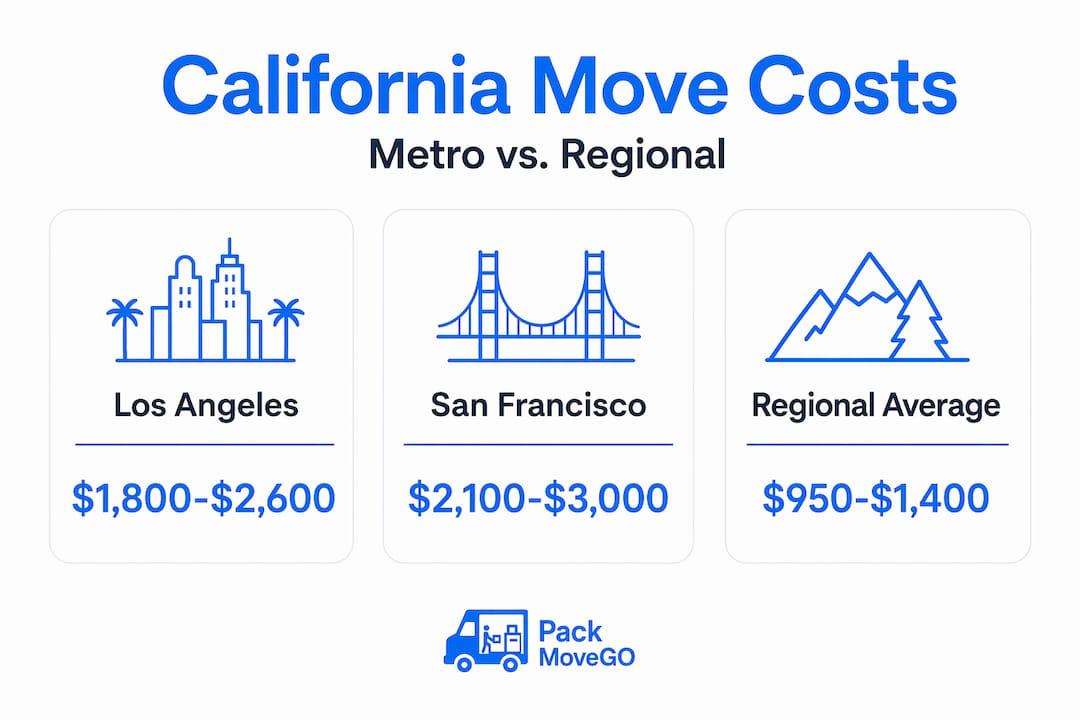
These are estimates, not guarantees. Actual costs depend on the specific variables covered in the sections below.
Key pricing methods: Local vs long-distance moves
Understanding the higher baseline, it is crucial to see how pricing actually works for different types of moves. Not all moves are priced the same way, and the method a mover uses directly affects how your final bill is calculated.
Local moves use hourly rates while long-distance moves typically use flat-rate pricing based on inventory weight and distance. This is a fundamental difference that changes how you should plan and budget.
For a local move in California, you will typically see a 2-person crew with a truck running somewhere between $120 and $200 per hour, depending on the market. A 3-person crew for a larger home might run $180 to $280 per hour. The final cost is total hours worked multiplied by the hourly rate, plus any add-on charges.

For long-distance moves, the mover conducts an inventory of your belongings, estimates the total weight, and uses that combined with the mileage to generate a flat rate. This is why a thorough walkthrough matters. If you forget to mention the piano, the garage full of tools, or the oversized sectional sofa, the quote will be inaccurate and the final bill will be higher.
Here is how to compare pricing models before signing anything:
- Ask for the per-hour rate and the minimum number of hours charged.
- Request the estimated total crew size and truck capacity.
- For long-distance moves, ask how inventory weight is calculated and whether an in-home survey is offered.
- Ask whether the estimate is binding or non-binding.
- Get everything in writing before giving a deposit.
The binding versus non-binding distinction is important. A binding estimate locks in the price regardless of actual weight or time, provided your inventory does not change. A non-binding estimate is an approximation that can be adjusted after the move based on actual conditions. Non-binding estimates offer less certainty and can result in a final bill that is 20% to 30% higher than the original quote.
| Estimate type | Price certainty | Risk | Best for |
|---|---|---|---|
| Binding | High | Low | Long-distance, large moves |
| Non-binding | Low | Higher | Simple, predictable local moves |
| Binding not-to-exceed | Very high | Very low | Moves where you want a firm ceiling |
Pro Tip: Always ask about a "binding not-to-exceed" estimate option. This type caps your cost at the quoted amount but allows the final price to be lower if the actual weight comes in under estimate. It is the most consumer-friendly option available.
Learning about moving services in California before you start collecting quotes helps you ask smarter questions. And if you want to understand how the moving process flows from start to finish, reviewing a packing and moving workflow will show you exactly where costs tend to accumulate.
Hidden fees and tricky line items to watch for
Once you understand base pricing, you need to know what can unexpectedly inflate your moving bill. This is where many people in California get caught off guard, sometimes adding hundreds or even thousands of dollars to the final invoice.
California-specific billing gaps frequently come from stairs, elevators, parking restrictions, fuel surcharges, and minimum-hour rules. These are not always disclosed upfront, but they are almost always in the fine print.
Common hidden fees to watch for in California:
- Fuel surcharges. Many movers add a fuel fee that is calculated separately from the hourly rate. This can range from a flat $50 to a percentage of the total bill.
- Stair and elevator fees. If movers have to carry items up or down stairs, most companies charge per flight per item, or a blanket fee per hour of stair use. Elevator waits also add billable time.
- Long carry fees. If the truck cannot park within a standard distance from your door, movers charge for the extra walking distance. In cities like San Francisco, this is extremely common due to narrow streets and permit-restricted parking.
- Minimum-hour rules. Most California movers enforce a 2-hour or 3-hour minimum, meaning even if your move takes 90 minutes, you are billed for the full minimum.
- Packing material charges. Boxes, tape, bubble wrap, and wardrobe cartons are rarely included in base pricing. These can add $150 to $500 to a mid-size move.
- Disassembly and reassembly fees. Taking apart and reassembling furniture is often billed separately, even when movers are the ones doing it.
On average, unexpected fees can increase a quoted moving price by 15% to 25% when logistics like stairs, parking, and minimum-hour rules are not addressed before moving day.
Pro Tip: Walk through your origin and destination properties with the same mindset a mover would. Count flights of stairs. Check if elevators need to be reserved. Note how far the nearest parking spot is from your front door. Then bring this information to every quote conversation and ask specifically what each factor will cost.
Understanding these gaps makes a real difference to your final bill. For practical guidance on keeping your move manageable, stress-free move tips walk through the logistics in plain language. If you are doing some of your own packing, packing tips for California can help you reduce the number of billable items and avoid last-minute material charges.
How to get accurate, transparent quotes
Knowing the pitfalls, here is how to ensure your quote is clear, fair, and covers everything you will need. The single biggest mistake people make is accepting a verbal or vague written estimate as a final commitment. It is not.
Itemized written estimates and verified licensing are the two most effective ways to prevent billing disputes and protect yourself throughout the moving process. These are not optional. They are essential.
Step-by-step: How to request and evaluate a moving quote
- Contact at least three licensed movers and request an in-home or video survey rather than a phone quote.
- Provide a complete inventory of everything being moved, including specialty items like pianos, safes, or antiques.
- Disclose all access issues upfront: stairs, elevators, parking limitations, long walks from door to truck.
- Ask each mover to provide a written, itemized estimate that breaks down labor, fuel, materials, and any potential surcharges separately.
- Compare the line items, not just the totals. A lower total may be missing charges that will appear on the final invoice.
- Verify that the mover holds a valid California Public Utilities Commission (CPUC) license and carries both liability and cargo insurance.
- Check customer reviews on independent platforms and look specifically for comments about final bills matching quoted prices.
Questions to ask every mover before you sign:
- What is your minimum charge, and what does it include?
- Is this a binding or non-binding estimate?
- What additional fees could apply to my specific move?
- How is payment collected, and are deposits refundable?
- What is your process if something is damaged?
Working with licensed California movers protects you in ways that go beyond cost. Licensing ensures accountability. Insurance protects your belongings. When something goes wrong, a licensed and insured mover has legal obligations that unlicensed operators do not. Before signing anything, reviewing moving agreement tips can help you understand what you are actually committing to.
The uncomfortable truth most guides miss about California moving costs
Most moving cost guides stop at the surface level. They give you a price range, tell you to get multiple quotes, and remind you to tip your movers. That is useful, but it misses the core issue most California residents and businesses face.
The real problem is the gap between the quote and the final bill. Not because movers are dishonest, but because people provide incomplete information and movers make optimistic assumptions to stay competitive. The quote is based on the best-case scenario. The invoice is based on what actually happened.
We have seen this pattern repeatedly. A homeowner in Los Angeles gets three quotes, picks the middle one, and ends up paying 30% more because nobody discussed the building elevator reservation policy or the parking permit required on their street. A business in San Diego books a commercial move based on a rough inventory, then discovers on moving day that three extra truck runs are needed for warehouse equipment that was not on the original list.
The information advantage goes to whoever has done this before. Movers know their billing structure inside and out. Most customers are doing this for the first time or have not moved in a decade.
The solution is straightforward. Treat every quote conversation as a negotiation backed by documentation. Bring a list. Ask about every fee. Get every answer in writing. Then review the final estimate line by line before signing.
Transparent and trusted California movers exist and are worth seeking out. The difference between a stressful moving experience and a smooth one is usually not luck. It is preparation and working with a mover whose quoting process matches reality.
Your neighborhood's logistics matter more than most people realize. Urban California is full of variables that standard quotes simply do not account for without direct discussion. The movers who work in your city know these variables. Ask them to explain how those variables affect your specific move before you commit to anything.
Transparent moving solutions for California residents and businesses
If you are ready to overcome moving cost confusion, here are next steps with trusted help. Sorting through quotes and fees on your own is manageable, but having an experienced partner makes it faster and far less stressful.
PackMoveGo's moving services are built around transparency for both residential and commercial customers across California. Every quote is itemized, every crew is licensed and insured, and every client has access to clear documentation before the move begins. Whether you need a local move across town or a long-distance relocation to another part of the state, the process is designed to eliminate billing surprises. You can also explore moving tips and tricks to continue building your knowledge, or get started directly with professional movers in California who will walk you through every cost before you sign anything.
Frequently asked questions
What factors most impact moving costs for homeowners in California?
Distance, weight, labor hours, packing services, specialty items, and access logistics like stairs or parking all significantly affect your total moving costs. Urban California conditions like traffic and parking restrictions add time and fees on top of those base factors.
How can I avoid hidden fees when moving in California?
Carefully review your written quote for every line item and ask specifically about fuel, minimum-hour rules, stairs, elevators, and parking before signing. California billing gaps are most commonly created by logistics that were never discussed during the quoting process.
Is it better to get a binding or non-binding estimate for a California move?
Binding estimates give you price certainty while non-binding estimates can change based on actual inventory or unforeseen conditions during the move. For most California moves, a binding or binding not-to-exceed estimate provides more protection.
How do I find licensed, reliable movers in California?
Verify mover licensing through the California Public Utilities Commission and check that the company carries liability and cargo insurance. Written, itemized estimates and transparent pricing practices are strong indicators that a mover operates with integrity.