

Signing a moving contract without reading it carefully can cost you far more than the move itself. Many Californians treat moving agreements like standard fine print, assuming the basics are covered and the rest is just formality. But a vague or poorly structured agreement can lead to surprise fees, unclear liability when something breaks, and no clear path forward if a dispute arises. Understanding what these documents actually say, and what they should say, gives you control over your move before the first box is packed.
Table of Contents
- What is a moving service agreement?
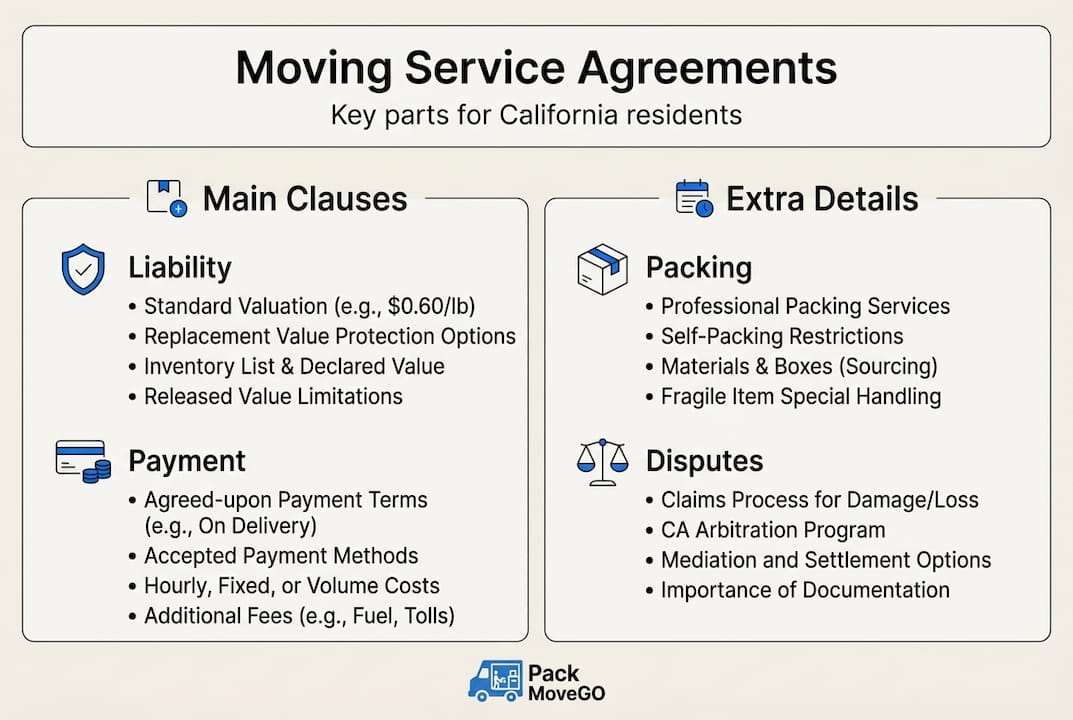
- Key elements found in moving service agreements
- How moving service agreements protect your interests
- Tips for reviewing and negotiating your moving agreement
- The real impact of moving service agreements: Our perspective
- Get started with a trusted California moving partner
- Frequently asked questions
Key Takeaways
| Point | Details |
|---|---|
| Define your agreement | Read and understand what a moving service agreement includes before signing. |
| Check key contract elements | Look for sections on services, pricing, liability, and dispute resolution. |
| Protect your interests | A thorough agreement can help minimize risks during your California move. |
| Negotiate when needed | Don't hesitate to negotiate or clarify terms for better service. |
| Seek expert guidance | Professional movers can help review contracts and avoid pitfalls. |
What is a moving service agreement?
A moving service agreement is a legally binding document between you and your moving company. It spells out exactly what the mover will do, what you will pay, and who is responsible if something goes wrong. Think of it as the rulebook for your entire move. Without one, you are relying on verbal promises, which rarely hold up when problems occur.
Moving service agreements outline the terms and conditions that govern a customer's move, including pricing, liability, and services provided. That means the document covers far more than just the pickup date and drop-off address. It sets the boundaries of the entire business relationship.
Here is what a standard moving service agreement typically covers:
- Services included: What the movers will actually do, such as packing, loading, transporting, unloading, and reassembling furniture
- Pricing structure: Whether you are paying a flat rate, an hourly rate, or a weight-based rate, along with any additional fees
- Insurance and liability: How your belongings are covered if they are lost or damaged during the move
- Timeline and deadlines: When your items will be picked up and delivered, and what happens if those dates change
- Payment terms: When and how you pay, including deposits and final payment requirements
- Cancellation policy: What fees or penalties apply if you change or cancel the move
For moves within California, these agreements are especially important because state regulations set minimum standards for moving companies operating here. Knowing what the contract must include under California law helps you spot gaps before you sign.
Pro Tip: Never sign a moving agreement the same day you receive it. Ask for 24 hours to review the document carefully, and if anything is unclear, request a written explanation before you commit.
Getting familiar with moving advice specific to California can also help you understand what a solid agreement should look like before you start comparing movers.
Key elements found in moving service agreements
Once you know what an agreement is, you need to know which specific terms carry the most weight. A contract that looks complete at first glance can still have gaps that leave you exposed.
Agreements typically include liability clauses, payment schedules, type of packing and transport, and dispute resolution procedures. Each of these elements plays a different role, and skipping over any one of them can create serious problems down the line.

Here is a comparison of how contract elements typically differ between residential and commercial moves:
| Contract element | Residential move | Commercial move |
|---|---|---|
| Liability coverage | Personal property per item | Equipment and inventory by value |
| Pricing structure | Hourly or flat rate | Custom quote based on volume |
| Service scope | Packing, transport, unload | Disassembly, IT equipment handling |
| Timeline flexibility | Fixed move date | Phased or off-hours scheduling |
| Dispute resolution | Arbitration clause | Often includes SLA provisions |
| Insurance requirements | Basic released value or full value | Commercial-grade coverage |
As you can see, commercial moves involve a much broader range of specialized concerns. A business moving office equipment or sensitive records needs very different protections than a family moving furniture. Using a residential template for a commercial move, or vice versa, is one of the most common and costly mistakes we see.
"The contract you sign is the move you get. If it is not written in, do not assume it is included."
Here are the most important things to check before you sign any moving agreement:
- Confirm the full list of services in writing. If a sales rep promised assembly or specialty packing, it must appear in the contract.
- Read every fee disclosure. Look for fuel surcharges, stair fees, long-carry fees, and after-hours charges.
- Check the liability limit per item. Basic released value protection pays only about 60 cents per pound, which is almost nothing for electronics or antiques.
- Review the delivery window. Long-distance moves often give movers a range of days, not a guaranteed date.
- Find the dispute resolution clause. Know whether disagreements go to arbitration or court, and in which jurisdiction.
- Verify the company's license. California movers must hold a Permanent Arbitration Agreement and a valid MTR number from the CPUC.
Pro Tip: Cross-reference the agreement against the written estimate you received earlier. Any service that appeared on the estimate but is missing from the contract is a red flag worth questioning before signing.
You can also check out a full moving services overview to understand what a thorough and transparent moving service should offer before you compare companies. Reading through moving tips can help you recognize what quality movers typically include in their agreements.
How moving service agreements protect your interests
Understanding the details is important, but knowing how these agreements protect you is even more vital for peace of mind.
A well-written moving agreement is not just paperwork. It is your primary tool for holding a moving company accountable. A detailed agreement helps prevent misunderstandings, clarify liabilities, and resolve conflicts if issues arise during your move. Without clear written terms, proving what was promised, and what went wrong, becomes very difficult.
Here is a concrete example. Suppose your movers arrive and announce a fuel surcharge that was never mentioned during your quote. If your contract does not include that charge, you have grounds to dispute it. If the contract does include vague language about "additional fees at the company's discretion," you may have very little recourse. The agreement is the difference between a problem you can solve and one you are stuck with.
"A signed agreement turns a verbal promise into an enforceable commitment."
Here are the most common problems that a clear moving agreement helps you avoid:
- Unexpected charges on move day that were never disclosed upfront
- Delays without compensation, where movers take longer than estimated with no penalty
- Incomplete service, where the crew leaves before finishing the agreed scope of work
- Damage disputes with no resolution path, where neither party has a clear process to follow
- Hostage freight situations, where movers hold your belongings until additional payment is made
- Liability gaps, where damaged items fall outside the coverage defined in the contract
California has specific consumer protections for people using professional moving services, but those protections only go so far if your contract does not align with them. State law requires movers to provide a written estimate and a copy of the Consumer Protection and Arbitration Agreement for moves within California. If your mover skips these steps, that is a warning sign. Knowing your rights starts with reading the agreement you sign.
Moves within California also fall under the oversight of the California Public Utilities Commission, which licenses household goods carriers. A valid agreement with a licensed mover gives you access to formal complaint procedures if problems escalate.
Tips for reviewing and negotiating your moving agreement
Once you know the benefits, putting this knowledge into practice is your next step.
Careful review and negotiation can help customers secure better terms, avoid hidden fees, and tailor services to specific needs. Most people assume moving contracts are fixed documents. They are not. Legitimate movers expect questions and are often willing to adjust terms to earn your business.
Follow this step-by-step process when reviewing your moving agreement:
- Read the full document before asking questions. Highlight anything that seems unclear or inconsistent with what you discussed verbally.
- Compare it to your written estimate. Every service listed on your estimate should appear in the contract, priced the same way.
- List your specific concerns. If you have fragile items, a narrow driveway, or a tight delivery window, find where those concerns are addressed in the contract.
- Ask for changes in writing. Do not accept verbal reassurances. Any modification to the standard contract must be documented and signed by both parties.
- Research the company's license and complaint history. Use the California Public Utilities Commission database to verify the mover's MTR number.
- Request full insurance documentation. Confirm that the mover's liability coverage matches what is written in the agreement.
- Do not sign under pressure. A reputable mover will give you time to review. A company pushing for an immediate signature should raise concerns.
When it comes to negotiation, most customers do not realize that pricing, service scope, and even liability terms can be adjusted. If you have high-value items such as antiques, artwork, or specialty electronics, ask for enhanced coverage to be written directly into the agreement. Some movers will offer full-value protection as a paid upgrade rather than including it as a default.
Pro Tip: Before your move date, use a moving checklist to track every term you negotiated and confirm that each one made it into the final signed agreement.
California-specific considerations matter here too. The state requires that any mover providing a binding estimate must honor that price unless a change order is agreed upon before the move. If conditions change on move day, you have the right to request a written amendment before work continues.
The real impact of moving service agreements: Our perspective
Here is something most moving guides will not tell you: generic, template-based moving contracts are designed to protect the mover, not you. Companies use standard agreements because they scale easily across thousands of customers. That efficiency works against you when your move has specific needs.
We have seen this play out repeatedly with California moves. A family relocating from San Francisco to San Diego discovered on delivery day that their agreement did not include elevator fees at the new building. A business moving office equipment found that the contract's liability cap was based on weight, not replacement value, leaving them with a fraction of what the damaged equipment was worth.
The uncomfortable truth is that the more complex your move, the less a standard template protects you. A one-bedroom apartment move might be fine with a basic agreement. But if you are relocating a business, moving specialty items, or coordinating a long-distance move with storage in between, a generic contract leaves significant gaps.
Customization is not just an upgrade. It is a necessity for moves that fall outside the simple point A to point B formula. We have seen clients save thousands of dollars and avoid weeks of dispute by simply asking their mover to add three or four specific clauses before signing. It takes an extra hour. The protection it provides can last years if something goes wrong.
Our practical advice is to treat the agreement review as seriously as you treat packing your most valuable items. Read insider moving strategies that reflect real California conditions, because the specifics of moving in this state, from traffic and building access to state regulations, make local knowledge a real asset.
Do not let the length or legal language of a moving agreement intimidate you into skipping it. The time you invest in understanding your contract is always worth it.
Get started with a trusted California moving partner
Ready to make your move? Discover how expert guidance turns these insights into practical solutions.
At PackMoveGo, we build transparency into every step of the moving process. That starts with clear, customized agreements that reflect your specific move, not a one-size-fits-all template.
Explore our full range of moving services to see exactly what is included and how we handle everything from packing to final delivery. If you want to go further, our library of moving tips and tricks gives you practical tools for reviewing agreements, comparing movers, and preparing for move day. And when you are ready to talk to a real team with real California experience, professional California movers at PackMoveGo are here to make the process clear, straightforward, and stress-free from quote to completion.
Frequently asked questions
Do moving service agreements cover liability for damaged items?
Most agreements include liability clauses for damaged items, but coverage levels and compensation amounts vary widely, so always read the specifics before you sign.
Can I negotiate the terms of my moving service agreement?
Yes, terms including pricing, service scope, and special provisions are often negotiable, and careful negotiation can help you avoid hidden fees and secure better coverage.
What happens if there is a dispute with my moving company?
Your service agreement should include a dispute resolution procedure, such as arbitration or a formal complaint process, so review that section closely before your move begins.
How do California rules affect moving service agreements?
California requires licensed movers to provide written estimates and follow state consumer protection standards, so a detailed agreement ensures your move meets those legal requirements and gives you a clear path to resolution if problems arise.