

Hiring a moving company in California feels simple until something goes wrong. Thousands of residents each year hand their belongings to movers who turn out to be unlicensed, uninsured, and untraceable. The 4,820 licensed firms operating in California in 2023 exist within a clear regulatory framework designed to protect you. Yet many homeowners and renters still skip the verification step. This guide breaks down what licensing actually means, what protections it gives you, what the insurance landscape looks like, and how to apply all of this to your next move with confidence.
Table of Contents
- What does it mean to be a licensed mover in California?
- Why choosing a licensed mover matters: Consumer protections and peace of mind
- The insurance landscape: Coverage, limitations, and smart decisions
- The economic and community impact of licensed movers in California
- The real difference: What most people miss about licensed movers
- Move with certified peace of mind: Why trust a licensed pro?
- Frequently asked questions
Key Takeaways
| Point | Details |
|---|---|
| Licensing means accountability | Licensed movers follow strict state requirements, offering legal and financial protections. |
| Insurance options matter | Understanding mover-offered and personal policies helps avoid costly gaps during relocation. |
| Verification is easy | You can quickly check a mover’s status online with their permit (T number). |
| Higher quality, less risk | Licensed movers deliver better service with fewer complaints or claims than unlicensed providers. |
| Choose smart, move safe | Hiring a licensed mover is the most reliable way to safeguard your home and belongings during a move. |
What does it mean to be a licensed mover in California?
Licensing is not just a certificate on a wall. In California, it represents a specific legal status that requires movers to meet ongoing standards before they can legally transport your belongings.
Two state agencies share oversight of this process. The California Public Utilities Commission (CPUC) issues the core operating permit. The California Bureau of Household Goods and Services (BHGS) handles registration, enforcement, and consumer complaints. Any moving company that operates intrastate residential moves must work within both frameworks.
The most important credential to know is the Household Goods Carrier Permit, also called a T number. According to California moving company rules, licensed movers must obtain this T number from the CPUC and register with BHGS, proving compliance with safety, insurance, and operational standards. Without it, a company is not legally permitted to move your household goods.
Here is what licensing actually requires a mover to maintain:
- Commercial liability insurance covering third-party property damage
- Cargo insurance protecting your belongings during transport
- Workers' compensation coverage for all employees
- Compliance with BHGS rate regulations and consumer disclosure rules
- A valid, searchable T number on the BHGS online tool
| Requirement | Licensed mover | Unlicensed mover |
|---|---|---|
| T number (CPUC permit) | Required | None |
| BHGS registration | Required | None |
| Cargo insurance | Required | Not verified |
| Consumer complaint process | Available | No recourse |
| Written estimates | Legally required | Optional or absent |
The BHGS conducts statewide enforcement sweeps to catch companies operating without proper credentials. In 2023, 4,820 licensed firms were verified through their online tool, giving you a clear way to check any company before signing anything. You can also visit our moving tips blog for guidance on what questions to ask during the verification process.
Pro Tip: Always ask for the mover's T number before requesting a quote. A legitimate company will share it without hesitation. If they can't provide one, stop the conversation there.
Why choosing a licensed mover matters: Consumer protections and peace of mind
Licensing creates a foundation of accountability that simply does not exist when you hire an unlicensed mover. The difference is not just administrative. It shows up directly in how your move is handled, priced, and resolved if something goes wrong.
California law requires licensed movers to provide a written not-to-exceed estimate before your move begins. This means the final bill cannot exceed the quoted price unless you authorize additional services. They must also give you a Consumer Protection Booklet, which explains your rights in plain language. The three mandated coverage levels are Basic (60¢ per pound), ACVP at $1 per $100 of declared value, and Full Value Protection (FVP) at $2 per $100.
"Licensed movers provide accountability via state oversight, reducing risks compared to unlicensed operations." — California Bureau of Household Goods and Services
With unlicensed movers, the risks are serious and well-documented:
- No insurance: If items are damaged or lost, you have no guaranteed coverage path
- Price gouging: Estimates can change arbitrarily with no legal ceiling
- Goods held hostage: Some unlicensed movers demand extra cash before unloading
- Theft: Without vetting or oversight, workers are not screened or accountable
- No legal recourse: Filing a complaint leads nowhere when there is no license on record
| Protection | Licensed mover | Unlicensed mover |
|---|---|---|
| Written not-to-exceed estimate | Yes | Rarely |
| State complaint process | Active via BHGS | None |
| Mandatory insurance coverage | Yes | Unverifiable |
| Consumer rights booklet | Required by law | Not provided |
| Workers' comp for movers | Required | Not guaranteed |
When you hire a licensed mover and a dispute arises, BHGS can investigate the company and take enforcement action. That leverage does not exist with unlicensed operators. Browse our moving services overview to see how a properly licensed operation handles your move from start to finish.
The insurance landscape: Coverage, limitations, and smart decisions
Understanding insurance is where many California renters and homeowners make expensive mistakes. Licensing ensures coverage is available. But the default option may not protect you the way you expect.
Here is how the three coverage levels work in practice:
- Basic coverage (60¢ per pound): This is the minimum required by law and is typically included at no extra charge. If your 50-pound television is damaged, you receive $30. That is it. For most people, this is far too little.
- Actual Cash Value Protection (ACVP) at $1 per $100: This covers items based on their depreciated market value. Better than Basic, but still not replacement cost.
- Full Value Protection (FVP) at $2 per $100: This is the strongest option. The mover is responsible for repairing, replacing, or paying the current market replacement value for damaged or lost items.
Pro Tip: For a move involving electronics, antiques, or high-value furniture, always select FVP or purchase a third-party moving insurance policy. The difference in cost is minimal compared to the potential loss.
One gap many people miss: your existing homeowners or renters insurance policy likely does not cover your belongings while in transit. Standard home policies often exclude items being moved in a commercial vehicle. You need to call your insurer and confirm before your move date.
Steps to protect your valuables before moving day:
- Request a full inventory list from your mover at booking
- Photograph high-value items from multiple angles before packing
- Confirm in writing which coverage level you have selected
- Contact your renters or homeowners insurer to ask about transit coverage
- Consider third-party moving insurance for items valued over $5,000
Our moving insurance tips section walks through each of these steps with practical examples. Skipping any one of them is where regret tends to start.
The economic and community impact of licensed movers in California
Licensing does not just protect individual consumers. It shapes an entire industry and the communities that depend on it.

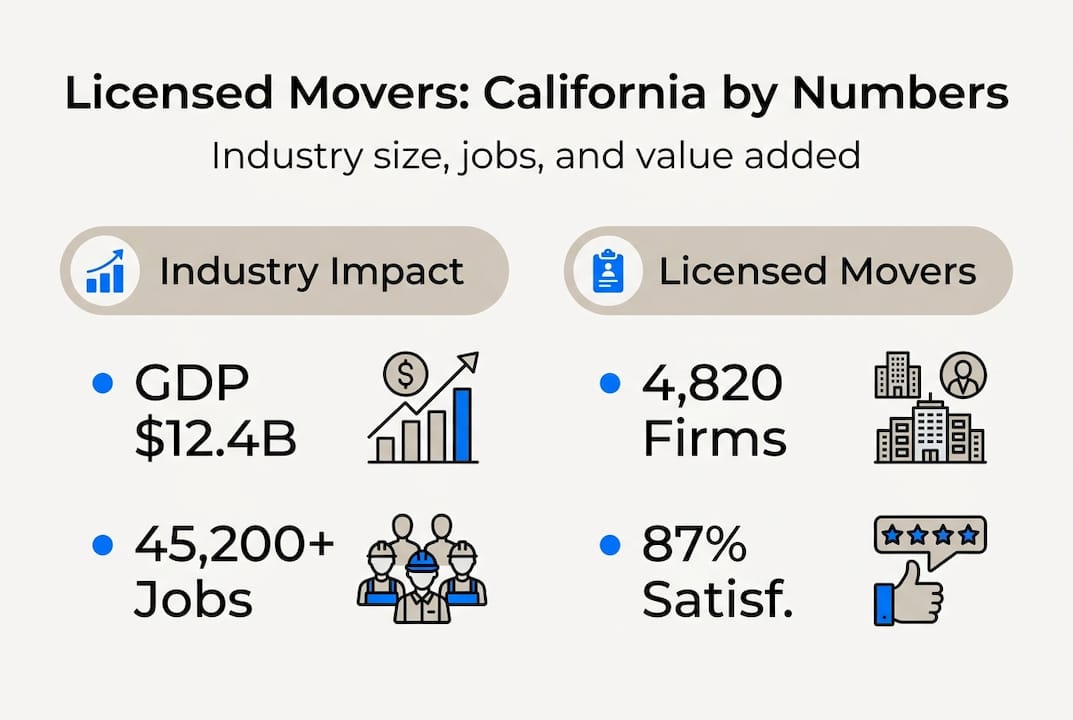
The California moving industry contributed $12.4 billion to state GDP in 2022 and employed over 45,200 people. These are not temporary gig workers. They are trained professionals operating within regulated labor standards, with injury protections and steady employment. That economic activity flows directly into local communities.
The data also shows that licensing drives quality outcomes. The same industry report found an 87% customer satisfaction rate and a 4.1% claims rate, meaning the vast majority of licensed moves finish without any formal dispute. The FMCSA recorded just 1.2 complaints per 100 moves among licensed operators. That is a low number given the physical complexity of relocating a household.
For renters specifically, licensed movers offer a benefit that often goes unnoticed: parking permit handling. In dense California cities like San Francisco or Los Angeles, securing a temporary no-parking zone for a moving truck requires permits from the city. Licensed movers know this process and often handle it on your behalf, saving you hours of bureaucratic back-and-forth and potential fines.
| Metric | California licensed movers (2022) |
|---|---|
| GDP contribution | $12.4 billion |
| Jobs supported | 45,200+ |
| Customer satisfaction | 87% |
| Claims rate | 4.1% |
| FMCSA complaints per 100 moves | 1.2 |
Licensing also raises the barrier to entry, which has a mixed effect. It ensures liability recourse for consumers and protects valuables. But it also means smaller operators face higher startup costs, which can limit competition in certain markets. For you as a consumer, the tradeoff is typically worth it. Browse the moving industry overview to understand how professional standards affect your moving experience.
The real difference: What most people miss about licensed movers
Most articles stop at "check the T number and you're fine." That is useful advice, but it misses something important.
A license does not guarantee integrity. What it does is create a strong system of incentives that makes bad behavior costly for the mover. Licensed companies risk losing their permit, facing BHGS enforcement, and accumulating public complaint records if they act badly. That risk shapes their behavior in ways that unlicensed operators simply do not experience.
The 91.2% DOT inspection pass rate and the 4.1% claims rate among licensed movers are not accidents. They reflect what happens when accountability is built into a system. Most unlicensed mover problems only surface after something goes wrong, and by then, you have very little power.
Smart consumers go one step further before signing any moving contract. They check the BHGS complaint history for the specific company, not just whether the license exists. They also read the written estimate line by line and confirm coverage levels in writing. Visit our expert moving advice for a pre-move checklist that covers exactly this process. Licensing is the floor, not the ceiling.
Move with certified peace of mind: Why trust a licensed pro?
You now have a clear picture of what licensing means, what protections it provides, and how to use that knowledge before your next move.
Working with licensed moving professionals means your move is covered by state-mandated insurance, written estimates, and real regulatory oversight. You are not guessing. At PackMoveGo, our full moving services are built around compliance, transparency, and your peace of mind from the first call to the final box. Get a free quote today, or explore our moving tips guide to prepare for a smooth, stress-free relocation across California.
Frequently asked questions
How can I verify if a mover is licensed in California?
You can verify a mover's license using the BHGS online lookup tool by searching for their T number, which all licensed California movers are required to have.
What's the main risk of using an unlicensed mover?
Using an unlicensed mover means no insurance, potential theft, price gouging after pickup, and no legal recourse if your belongings are damaged or held.
What insurance coverage levels are required by law for California movers?
Licensed movers must offer three coverage options: Basic at 60¢ per pound, ACVP at $1 per $100 of declared value, and Full Value Protection at $2 per $100.
Do homeowners or renters insurance policies cover items during a move?
Most standard home and renters policies do not cover transit, so you should contact your insurer before moving day and consider purchasing dedicated moving insurance.
How much does a typical local move with a licensed mover cost in California?
The average local move costs around $4,200 in California, though the total varies based on distance, volume of items, and the coverage level you select.