

Most businesses discover that moving an office is far more complicated than moving a home. What is business moving, exactly? At its core, it is the planned transfer of a company's people, equipment, operations, and culture from one physical location to another. But that definition only scratches the surface. Business moving touches everything from IT infrastructure and client relationships to employee morale and long-term financial strategy. This guide breaks down what corporate moving actually involves, how the process works, what it costs, and how to do it without losing ground.
Table of Contents
- Key takeaways
- What is business moving: definition, scope, and common reasons
- Phases and timeline of a typical business move
- Key challenges and logistical considerations
- Cost factors and financial planning for a business move
- Best practices for a successful business relocation
- My take on treating business moving as a strategic decision
- How Packmovego supports your business relocation
- FAQ
Key takeaways
| Point | Details |
|---|---|
| Business moving is a strategic process | It involves transferring operations, people, and equipment while maintaining continuity and minimizing disruption. |
| Plan 12 to 18 months ahead | A successful relocation timeline spans 12 to 18 months to allow thorough planning and avoid rushed decisions. |
| Costs vary significantly | Business relocation costs range from $1,500 to $30,000+ depending on office size, equipment, and destination. |
| Pre-move audits save money | Identifying assets that cost more to move than replace protects your budget before the first box is packed. |
| Phased moves reduce downtime | Moving by department or floor keeps operations running and prevents prolonged shutdowns. |
What is business moving: definition, scope, and common reasons
Business moving, also called corporate moving or commercial relocation, is the process of transferring a company's physical operations from one location to another. This includes relocating employees, office furniture, equipment, technology infrastructure, files, and in some cases, entire warehouse or manufacturing setups. The definition of business moving extends beyond carrying boxes. It means maintaining operations during the transition, managing people through significant change, and positioning the company for its next stage of growth.
Companies move for a range of reasons, and understanding those reasons clarifies what makes each relocation unique:
- Growth: A team that outgrows its current space needs more room or a better-configured layout to function at full capacity.
- Cost reduction: Relocating to a market with lower rent, utilities, or tax obligations directly improves margins. Businesses moving from California to states like Nevada, for example, often see immediate savings from eliminated state income tax and utility rates 30 to 40% lower.
- Talent access: Proximity to universities, tech hubs, or specialized labor pools is a major driver. More than 65% of Fortune 500 companies use structured relocation programs as part of their talent acquisition strategies.
- Market entry: Moving closer to a target customer base or key partners can shorten sales cycles and reduce logistics overhead.
- Lease expiration: Sometimes a move is simply triggered by an expiring lease and the decision not to renew.
Each of these scenarios involves different priorities, timelines, and complexity. A company moving across town to a larger suite faces a different challenge than one relocating to another state. Both qualify as business moving. Neither is simple.
Phases and timeline of a typical business move
A business relocation rarely happens in a matter of weeks. A 12 to 18 month timeline is standard for a well-executed corporate move, particularly for mid-sized to large organizations. Rushing this process is one of the most common and costly mistakes companies make.
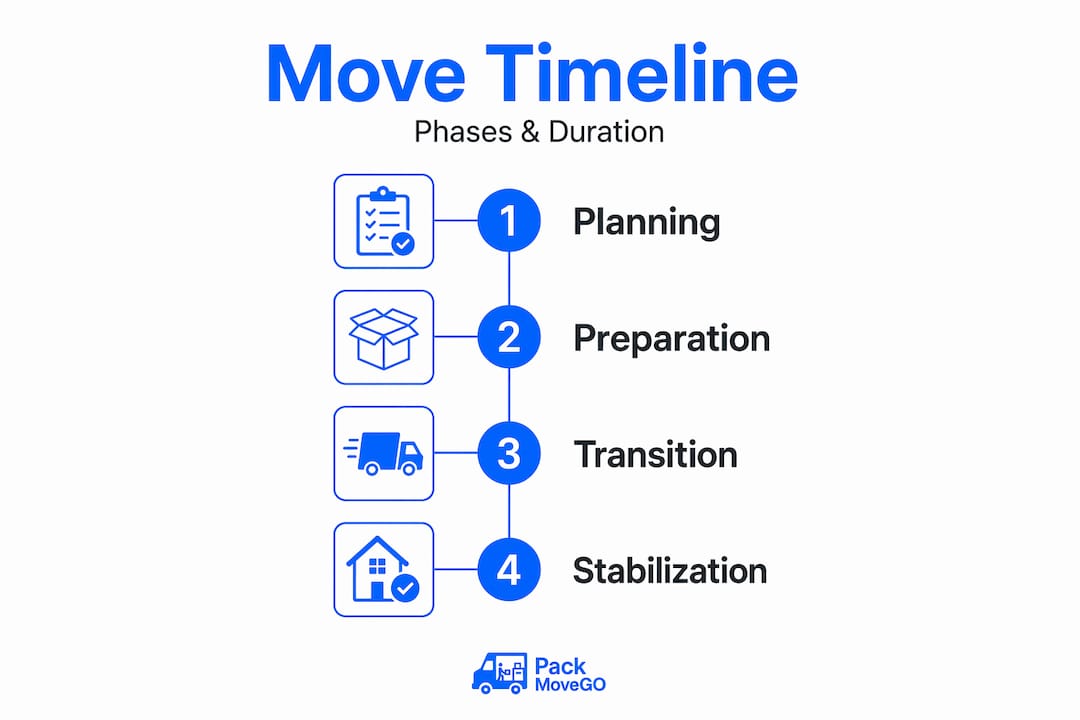
Here is how that timeline typically breaks down:
| Phase | Duration | Key activities |
|---|---|---|
| Strategic planning | Months 1 to 4 | Location evaluation, financial modeling, leadership alignment |
| Preparation | Months 4 to 9 | Lease negotiation, space design, vendor selection, employee communication |
| Transition | Months 9 to 14 | Physical move, IT setup, department phasing, client notifications |
| Stabilization | Months 14 to 18 | Operations normalization, culture rebuilding, feedback and adjustments |
The strategic planning phase is where the most important decisions happen. Leaders must evaluate every cost factor — not just rent, but tax obligations, utilities, workforce quality, and commute impact on existing employees. Skipping or compressing this phase tends to produce surprises that show up later as budget overruns or retention problems.
The preparation phase is where communication becomes critical. Employees need to understand what is changing, why, and what it means for their roles and commutes. Clients and vendors need advance notice so they can update records and plan accordingly.
Pro Tip: Set a dedicated internal communication channel for relocation updates as early as month two. Employees who feel informed are significantly more likely to stay through and after the transition.
The transition phase is the most operationally intense period. This is when the physical move happens, IT teams reconfigure infrastructure, and department leads manage the day-to-day impact on their teams. The stabilization phase is often underestimated. Getting staff settled, rebuilding team rhythms, and addressing culture gaps after a move takes deliberate effort.

Key challenges and logistical considerations
Business moving involves a set of challenges that most companies do not fully anticipate until they are in the middle of them. Knowing what to expect allows you to build solutions into the plan rather than scrambling for them under pressure.
The most common challenges include:
- Operational downtime: Disruptions during a move can cause delays and lost revenue, making business continuity planning non-negotiable. Even a few days of reduced output adds up quickly.
- Employee retention: Some employees will not make the move, particularly if the distance is significant. Identifying flight risks early and creating relocation support packages helps reduce attrition.
- Unexpected costs: Permits, elevator reservations, insurance certificates for the building, and after-hours labor fees all add up. Urban locations especially, where building constraints like freight elevator access and loading dock restrictions create delays, tend to surface hidden costs.
- Specialized equipment: Servers, medical devices, lab equipment, and custom furniture require expert handling. Standard movers are not always qualified for these items.
One of the most practical steps any company can take before a move is conducting a thorough pre-move audit. Skipping a pre-move audit risks paying to transport equipment and furniture that would cost less to replace outright. Go through every room, floor, and storage area. Categorize each asset: move it, sell it, donate it, or dispose of it.
Pro Tip: Photograph every workstation and server rack before disassembly. This creates a reference for reassembly at the new location and documents the condition of equipment for insurance purposes.
You can also reduce downtime significantly by using a phased moving approach. Moving by department or floor keeps part of the business operational at all times rather than shutting everything down for days. For guidance on safely preparing office equipment for the physical move, the office equipment packing guide from Packmovego walks through the process step by step.
Cost factors and financial planning for a business move
Business relocation costs vary more than most executives expect. The range spans from $1,500 for a small office to over $30,000 for a large, complex move with specialized equipment and long-distance logistics. The moving company fee itself is just one line item.
Here is a comparison of the major cost categories against potential financial benefits:
| Cost factor | Estimated impact | Potential savings or benefit |
|---|---|---|
| Movers and labor | $1,500 to $30,000+ | Avoids asset damage with professional handling |
| IT infrastructure setup | $5,000 to $50,000+ | Opportunity to upgrade systems and reduce tech debt |
| Employee relocation support | $2,000 to $10,000 per person | Retains key talent through the transition |
| Temporary storage | $500 to $5,000 | Enables phased moves without cluttering new space |
| Downtime and lost productivity | Varies by industry | Offset by post-move efficiency gains |
| Lower rent or taxes in new market | Ongoing cost | Can recover full move cost within 12 to 24 months |
Leaders should evaluate all cost factors including tax, utilities, and workforce quality when considering relocation rather than treating rent as the only variable. The importance of business relocation from a financial perspective is most visible when companies do a full cost-benefit analysis that projects three to five years out.
Build in a contingency buffer of 15 to 20% on top of your total projected costs. Unexpected delays, permit issues, and last-minute vendor changes are common enough that treating your initial budget as fixed is a setup for stress.
Best practices for a successful business relocation
Knowing how to move a business efficiently comes down to preparation, communication, and the right professional partners. These steps reflect what well-executed business relocations have in common:
- Assign a relocation manager. One person needs clear ownership of the project. This role coordinates across departments, vendors, and leadership. Without a single point of accountability, tasks fall through.
- Build a cross-functional move team. Include representatives from IT, HR, operations, and facilities. Each group has different needs and different timelines.
- Communicate early and often. Employees, clients, and key vendors all need advance notice. Silence breeds rumors. A consistent update cadence keeps trust intact.
- Hire specialized commercial movers. A company experienced in business transition services understands building logistics, equipment handling, and the pace of a commercial move. General residential movers are not the right fit for a company relocation.
- Schedule moves during off-peak hours. Weekend or overnight moves reduce disruption to operations and often come with fewer building logistics conflicts.
- Back up all data before anything moves. IT infrastructure should be fully backed up and tested before a single server is disconnected. This is non-negotiable.
- Use storage strategically. Placing non-essential items in temporary storage during a phased move simplifies relocation significantly by keeping the new space clear for critical setup.
- Plan the post-move period. Budget time and resources for team stabilization. Culture rebuilding after a major move takes deliberate effort, and leaders who ignore it tend to see elevated turnover in the months following.
My take on treating business moving as a strategic decision
I have watched companies treat an office move the way they would treat ordering office supplies. Assign someone, get it done, move on. And every time, that approach costs more, takes longer, and disrupts more than anticipated.
Here is what I have found from working in and around commercial relocations: the businesses that come out ahead are the ones that treat the move as a strategic market entry, not a logistical errand. They are asking different questions from the start. Not just "where can we afford space?" but "what does this location do for our growth, our talent pipeline, and our client access over the next five years?"
The culture dimension is the most underestimated. When a company moves, even across town, the social fabric of the workplace gets shaken. Commutes change. The lunch spots change. The office energy changes. Leaders who invest in rebuilding team culture after a move see better retention and faster performance recovery. Those who treat the physical move as the finish line are often surprised by the attrition that follows.
My practical advice: plan earlier than feels necessary, hire professionals who specialize in commercial moves, and do not skip the post-move stabilization phase. The businesses that do this well come out with better operations, lower costs, and a more energized team. That is the real upside of getting business moving right.
— Support
How Packmovego supports your business relocation
When a business relocation is planned well, the physical move itself should be the least stressful part of the process. That is where the right commercial mover makes the difference.
Packmovego provides specialized commercial moving services across California, built specifically for businesses that need reliable, licensed, and insured support for office and corporate relocations. From packing office equipment and managing transportation to coordinating storage during phased moves, the team handles the logistics so your operations stay on track. Whether you are moving a company office across town or relocating to a new region, Packmovego offers free quotes, 24/7 support, and a clear process that covers every step. You can also explore moving tips and best practices for businesses planning their next relocation. Contact Packmovego today to start your relocation plan with professionals who understand what business moving actually demands.
FAQ
What is business moving, exactly?
Business moving is the process of transferring a company's employees, equipment, operations, and physical workspace from one location to another. It encompasses planning, logistics, IT infrastructure, communication, and post-move stabilization.
How long does a business relocation take?
A well-executed business relocation typically takes 12 to 18 months from strategic planning through stabilization. Smaller moves may be completed faster, but rushing the process increases the risk of costly disruptions.
What does business moving cost?
Business relocation costs range from $1,500 to over $30,000 depending on office size, distance, equipment complexity, and destination market. Additional costs for IT setup, employee support, and temporary storage should be included in any realistic budget.
What is a pre-move audit and why does it matter?
A pre-move audit is an inventory review that identifies which assets are worth moving, replacing, or disposing of before relocation day. Skipping this step often means paying to transport equipment that costs less to replace, which wastes both budget and time.
How do phased moves help businesses stay operational during relocation?
Phased moves relocate one department or floor at a time rather than shutting down the entire office at once. This approach keeps part of the business running throughout the transition and significantly reduces lost productivity and revenue during the move.