

Relocating in California can feel like reading a contract written in a foreign language. Movers throw around terms like "bill of lading," "non-binding estimate," and "released value protection" as if everyone already knows what they mean. Most homeowners and business owners do not, and that gap in understanding costs real money. This guide breaks down the most important moving industry terms, explains what they mean in plain language, and shows you how to use that knowledge to plan smarter, avoid surprises, and choose the right moving partner for your next California relocation.
Table of Contents
- Why understanding moving industry terms matters
- Core moving industry terms: Definitions and real-world examples
- Specialized terms for California relocations
- Applying industry terms: Questions to ask and red flags to watch for
- The hidden power of language in your moving journey
- Ready to move? Let PackMoveGo streamline your relocation
- Frequently asked questions
Key Takeaways
| Point | Details |
|---|---|
| Clarity prevents surprises | Knowing industry terms up front reduces confusion and prevents unexpected costs during your move. |
| Definitions shape decisions | Understanding moving jargon helps you compare services wisely and ask smart questions before booking. |
| California rules matter | Regulatory and insurance terms specific to California can affect your moving process, so it pays to ask about compliance. |
| Apply your knowledge | Using industry terms empowers you to negotiate, avoid scams, and select the right provider for your needs. |
Why understanding moving industry terms matters
Jargon is not just confusing. It can be expensive. When you sign a moving contract without understanding the terms, you are essentially agreeing to conditions you cannot evaluate. That is a problem whether you are moving a two-bedroom apartment in Sacramento or relocating an entire office from Los Angeles to San Francisco.
Here is what typically goes wrong when movers and clients are not on the same page:
- Unexpected charges appear on the final invoice because a service was included in the estimate but not explicitly defined.
- Delays happen because the scope of the job was unclear from the start.
- Lost or damaged goods go uncompensated because the client did not understand their liability coverage.
- Disputes escalate because both parties interpreted the same contract language differently.
For residential moves, the financial stakes are personal. For commercial relocations, unclear terms can affect business operations, employee schedules, and lease timelines. Either way, the result is unnecessary stress.
Understanding moving services terminology prevents miscommunication and unexpected charges. Knowing what you are agreeing to before you sign protects your budget and your belongings.
The good news is that industry terms are not complicated once someone explains them clearly. Most of the language movers use follows a standard pattern across the industry. Once you learn the core vocabulary, you can read any estimate or contract with confidence.
Checking moving tips and advice before your move is one of the simplest ways to prepare. Informed clients ask better questions, negotiate more effectively, and tend to have smoother moves overall. Knowledge is a practical tool here, not just background information.
Businesses benefit especially from this clarity. Commercial moves often involve specialized equipment, multiple pickup points, and tight scheduling windows. Every ambiguous term in a contract is a potential delay or added cost. Residential movers face similar risks, particularly when storage, long-distance transport, or fragile items are involved.
Understanding terminology also helps you compare quotes accurately. Two estimates may look very different on paper, but if one includes packing services and the other does not, they are not actually comparable. Only when you know what each line item means can you evaluate which quote delivers the better value.
Core moving industry terms: Definitions and real-world examples
The moving industry uses a consistent vocabulary across most providers. Here are the terms you are most likely to encounter and what they actually mean.
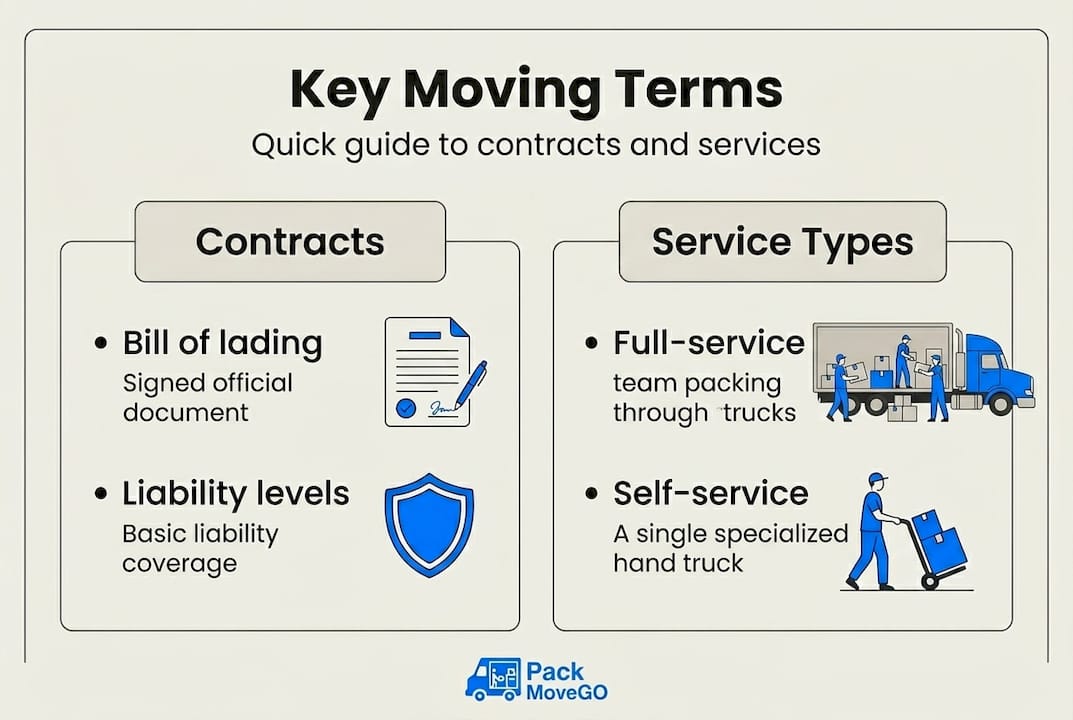
Full-service move: The mover handles everything, including packing, loading, transport, unloading, and unpacking. You pay more but do less.

Self-service move: You pack your own items. The mover handles transport only. Lower cost, more work on your end.
Broker: A company that connects you with a carrier but does not perform the move itself. Brokers are not always upfront about this distinction, so always ask whether the company contacting you will be the one physically moving your belongings.
| Term | What it means | Why it matters |
|---|---|---|
| Bill of lading | Legal contract between you and the mover | Outlines all services, charges, and responsibilities |
| Binding estimate | Fixed price regardless of actual weight or time | Protects you from cost increases |
| Non-binding estimate | Price that can change based on actual conditions | Final cost may exceed the quote |
| Inventory list | Itemized record of your belongings | Essential for insurance claims |
| Released value protection | Basic liability at no extra cost | Covers only $0.60 per pound per item |
| Full value protection | Full replacement or repair for lost or damaged items | Costs more but provides real coverage |
Pay close attention to how moving service options are described in any quote you receive. Different terms indicate distinct services and responsibilities, which means a "basic move" from one company may include things that cost extra with another.
When it comes to storage, ask whether the facility is climate-controlled, how access works, and whether your insurance extends to items in storage. These details are rarely volunteered upfront.
Pro Tip: Before booking any mover, ask them to define every service listed on your estimate. A legitimate company will explain each item without hesitation. If a provider gets evasive or rushes you, that is a warning sign worth noting. You can also review moving advice to build your pre-booking checklist.
Specialized terms for California relocations
California has its own regulatory framework for moving companies, and understanding it protects you from unlicensed or underinsured providers.
The California Public Utilities Commission (CPUC) oversees household goods movers operating within the state. Any licensed mover in California must have a CPUC permit number. You can verify this before signing anything.
Here is what to know about local definitions and requirements:
- Intrastate move: A move that starts and ends within California. Regulated by the CPUC.
- Interstate move: A move that crosses state lines. Regulated by the Federal Motor Carrier Safety Administration (FMCSA).
- Carrier: The company physically performing the move, as opposed to a broker.
- Tariff: The published rate schedule a mover uses to calculate charges. In California, movers are required to provide this on request.
- Valuation: The declared value of your belongings for liability purposes, not the same as insurance.
| Regulation area | California requirement |
|---|---|
| Carrier licensing | Valid CPUC permit required for intrastate moves |
| Insurance minimums | Cargo and liability coverage mandated by the CPUC |
| Written estimates | Required for moves over a certain value |
| Consumer rights notice | Must be provided to all residential customers |
California-specific regulations affect how movers price and document their services. Additionally, California moving insurance rules mean that liability language in your contract must meet state minimums, and anything below those minimums is a red flag.
Pro Tip: Before signing any contract with a California mover, ask for their CPUC permit number and verify it online. This single step filters out many illegitimate providers and confirms that the company meets state insurance requirements.
Applying industry terms: Questions to ask and red flags to watch for
Learning the terms is only useful if you apply them. Here is how to put this knowledge to work when evaluating moving companies.
Start with these questions before you book:
- Is this a binding or non-binding estimate?
- Are you a carrier or a broker?
- What valuation coverage is included, and what are my upgrade options?
- Is there a tariff I can review before signing?
- What is your CPUC permit number?
- Are there any additional fees for stairs, long carries, or storage?
- How do you handle claims for lost or damaged items?
These are not aggressive questions. They are standard. Any professional mover should answer them clearly and without hesitation. Asking about service definitions helps avoid hidden fees and complications that catch clients off guard after the move is already underway.
Watch for these warning signs:
- A quote that seems unusually low with no itemization.
- Pressure to sign quickly without time to review the contract.
- No physical address or CPUC permit number available.
- Verbal promises that contradict the written estimate.
- A contract that uses vague terms like "standard service" without defining them.
Contracts that rely on vague language are not accidents. Unclear wording benefits the provider, not the client. If you cannot get a straight answer about what a term means, that itself is information.
Pro Tip: Keep a short cheat-sheet of key moving terms with you during calls or site visits. When a mover uses a term, reference your list. If their definition does not match, ask them to clarify in writing. More moving tips are available to help you prepare for these conversations.
The hidden power of language in your moving journey
Here is our honest perspective: most moving disputes are not about bad movers. They are about mismatched expectations created by language neither party took time to define.
We have seen clients sign contracts with non-binding estimates expecting a firm price, only to receive a final invoice 30% higher. We have seen businesses assume "full service" included disassembly of workstations when it did not. In almost every case, one conversation before booking would have prevented the problem.
The uncomfortable truth is that moving contracts favor whoever understands them better. When you know what a bill of lading is, what released value protection actually covers, and why "broker" versus "carrier" matters, you negotiate from a stronger position.
Language is not a barrier. It is a tool. Use it.
We encourage every client to read their contract fully and ask questions until they are satisfied. That is not being difficult. That is being prepared. For expert moving guidance before your next relocation, knowledge is your best starting point.
Ready to move? Let PackMoveGo streamline your relocation
Now that you understand the language movers use, you are ready to make informed decisions about your California relocation.
PackMoveGo offers clear, jargon-free communication from your first quote to your final delivery. Our team explains every service, every charge, and every contract term before you sign anything. Whether you need residential moving, commercial relocation, or access to packing supplies to handle things yourself, we have the resources to support you. Explore our full range of moving services and read our moving tips guide to plan your move with confidence. Get your free quote today and experience a straightforward move.
Frequently asked questions
What is a 'bill of lading' in moving services?
A bill of lading is a legally binding document that outlines the full agreement between you and your mover, covering services rendered and all applicable charges. Keep a copy until your move is complete and all claims are resolved.
How do binding and non-binding estimates differ?
Binding estimates protect your budget by locking in a fixed price, while non-binding estimates can increase based on actual weight, time, or services used. Always confirm which type applies to your quote before signing.
Which insurance terms should California movers know?
You need to understand liability coverage levels and confirm the mover complies with California insurance requirements for motor carriers, as these rules directly affect how much you can recover if something goes wrong.
What are red flags when hiring moving services?
Watch for vague estimates, pressure to sign quickly, and providers that refuse to explain contract language clearly. Transparency in all terms is a basic standard for any legitimate moving company.
Recommended
- PackMoveGo - Professional Moving & Packing Services
- Moving Tips & Advice - PackMoveGo Blog
- Our Services - PackMoveGo | Residential, Commercial & Long Distance Moving
- Guide to relocation logistics: smooth and stress-free moves
- Executing a Low-Stress Local Move | Moving Tips