

Moving day is high-risk for your belongings, yet most people assume their homeowners or renters policy has them covered. It doesn't. Understanding what is moving insurance, how it works, and which options actually protect you can be the difference between full reimbursement and a check that barely covers postage. This guide breaks down every major coverage type, explains how valuation coverage differs from actual insurance, and helps you decide what protection your specific move actually needs.
Table of Contents
- Key takeaways
- What is moving insurance and how does it work
- Third-party moving insurance explained
- Packing liability and who is responsible
- When moving insurance is especially necessary
- How to file a moving insurance claim
- My take on what most people get wrong
- Move with confidence: Packmovego has you covered
- FAQ
Key takeaways
| Point | Details |
|---|---|
| Valuation is not insurance | Movers offer liability coverage, not insurance; only licensed insurers sell true moving insurance policies. |
| Default coverage is minimal | Released Value Protection pays as little as $0.60 per pound, which rarely reflects actual item value. |
| Third-party policies fill the gaps | Separate moving insurance can cover disasters, theft, and mold that valuation coverage excludes. |
| Documentation is your best protection | Photographing and inventorying items before the move is the strongest defense against rejected claims. |
| Business moves need extra attention | Commercial relocations often involve high-value equipment that requires customized coverage beyond standard options. |
What is moving insurance and how does it work
Before anything else, you need to know one fact that most moving companies won't say upfront: valuation coverage is not insurance. It is the mover's legal liability for your belongings. Actual moving insurance is a separate product sold by licensed insurance companies. The two terms get used interchangeably online, but they are completely different things with different rules, different protections, and different payout standards.
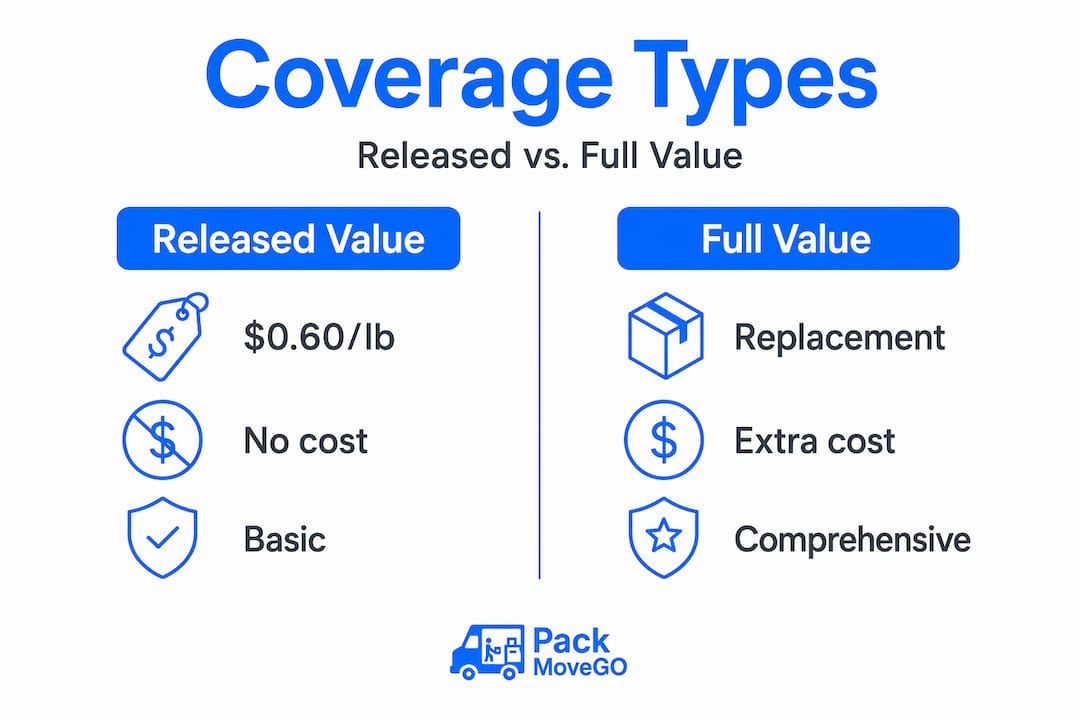
Federal law requires interstate movers to offer two liability options. The first is Released Value Protection and the second is Full Value Protection. Most people default to the first option because it costs nothing. That decision often costs them far more later.
Here is how each option works in practice.
| Coverage type | Cost | Compensation standard | Best for |
|---|---|---|---|
| Released Value Protection | Free | $0.60 per pound per article | Low-value, bulky items |
| Full Value Protection | Additional charge | Repair, replacement, or cash value | Electronics, furniture, valuables |
| Third-party moving insurance | Varies by policy | Market or agreed value, broader perils | High-value or irreplaceable items |
A 50-inch TV weighs roughly 45 pounds. Under Released Value Protection, if the movers damage it completely, you receive $27. The TV cost you $800. That gap is why understanding your coverage options for moving matters before you sign anything.
Full Value Protection costs more, but it obligates the mover to repair the damaged item, replace it with something of similar kind and quality, or pay you its current market value. The catch is that full value protection plans vary in how individual companies calculate replacement value and apply deductibles. Read the details carefully. What counts as "replacement value" under one company's plan may not match what you expect.
Pro Tip: Ask your moving company to see the full written terms of their Full Value Protection plan before your move date. Pay specific attention to deductible amounts and any exclusions for antiques, artwork, or electronics.
Third-party moving insurance explained
Even Full Value Protection has limits. It typically does not cover natural disasters, flooding, mold in storage, or theft that happens outside the mover's direct control. That is exactly where third-party moving insurance steps in, offering higher limits, customizable deductibles, and coverage for perils that valuation plans simply exclude.
You purchase third-party moving insurance from a licensed insurer, not your mover. There are several types to know:
- Trip transit insurance. This covers theft, disappearance, and fire during transport. However, trip transit insurance may not cover breakage or damage in a storage facility, so read the fine print before assuming storage is included.
- Special perils coverage. Broader than trip transit, this covers a wider range of incidents including some natural disaster scenarios. Useful if you are moving to or through areas prone to weather events.
- Floater policies for valuables. If you own jewelry, fine art, collectibles, or instruments worth significant money, a scheduled personal property floater attached to your existing homeowners policy may provide the most tailored protection.
One point that often surprises people: homeowners and renters insurance generally do not cover belongings while they are being handled by professional movers. Your policy covers your home, not a moving truck in transit. Before your move, call your insurance agent and ask specifically about transit coverage. Some policies offer it as a paid add-on, but you need to ask.
Pro Tip: Compare at least two third-party moving insurance quotes before your move. Prices and coverage terms vary significantly between providers, and the cheapest option is rarely the most protective for high-value items.

When does third-party insurance genuinely make sense? Think about the total replacement value of everything you own. If that number exceeds $50,000, and most furnished homes easily reach that threshold, the cost of a third-party policy is almost always worth it. For anyone moving fine art, musical instruments, or wine collections, there is no scenario where valuation coverage alone is adequate.
Packing liability and who is responsible
This section matters more than most people realize. Movers carry limited liability for boxes you pack yourself, and that distinction has rejected more claims than almost any other technicality in the moving process.
When professional movers pack your boxes, they accept responsibility for the contents if damage occurs. When you pack the box yourself, the story changes. Movers are generally not liable for damage to owner-packed boxes unless you can prove negligence on their part. That means if your TV survived the truck but the box was dropped during a moment you did not witness, proving negligence is extremely difficult.
The practical solution is thorough documentation before you seal anything. Follow this process:
- Create a written inventory. List every item going into each box with a brief description and estimated value. Number the boxes and keep a master list.
- Photograph contents before sealing. Take clear photos of fragile items and electronics. Capture serial numbers where visible. Photographic documentation before sealing is your primary proof that damage happened during the move, not before.
- Label boxes clearly. Mark fragile boxes on all sides, not just the top. Note which side should face up. These labels also help during claims because they establish that the mover was on notice about the contents.
- Use a packing inventory app or spreadsheet. Digital records are harder to lose than paper and easier to share with a claims adjuster. You can find practical guidance in these California move packing steps to structure your documentation process.
Pro Tip: Film a short walkthrough video of your packed boxes and living space the day before the move. Video timestamps provide strong supporting evidence if you need to file a claim later.
When moving insurance is especially necessary
Not every move carries the same risk. A local apartment move with a few pieces of furniture sits at a very different risk level than a cross-country relocation of a five-bedroom home or a commercial office with expensive equipment.
Here are the situations where moving insurance coverage is not optional, it is necessary:
- Long-distance or interstate moves. The more time your belongings spend in transit, the higher the exposure to damage, theft, and accidents. Federal law mandates that movers offer valuation options for interstate moves, but that does not mean those options are enough.
- High-value residential moves. If you own antiques, original artwork, wine collections, or custom furniture, the standard valuation system cannot compensate you adequately. These items often require appraisals and specialized floater coverage.
- Commercial relocations. Businesses moving offices or facilities face a different category of risk entirely. Servers, medical equipment, manufacturing machinery, and proprietary documents require coverage levels that standard residential moving insurance does not address. Working with a moving service for California relocations that understands commercial needs makes a measurable difference.
- Moves involving storage. If your belongings will sit in storage for any period during the transition, confirm explicitly whether your coverage extends to the storage facility and for how long.
- Moves by first-time renters or buyers. People who have never gone through a professional move often underestimate total item values. Run an actual replacement cost estimate before deciding coverage is unnecessary.
The cost-benefit math is straightforward. Third-party moving insurance for a standard two-bedroom move typically runs between $100 and $300 depending on declared value and coverage type. Compare that to replacing a laptop, a flat-screen TV, and a sofa out of pocket after a damage event. The insurance almost always wins.
How to file a moving insurance claim
Filing a claim is where preparation either pays off or fails completely. Most people only discover they did not document enough once they are already in the middle of a dispute.
Follow these steps if damage occurs:
- Note damages before the movers leave. Walk through your items on delivery day. If you see damage, note it on the delivery paperwork before signing. Your signature on an unmarked delivery receipt can be used to argue items arrived in good condition.
- File the claim promptly. There are strict time limits for filing claims with moving companies and insurance providers. Missing a deadline can void your claim entirely regardless of how legitimate the damage is.
- Submit full documentation. Send your pre-move photos, inventory list, and photos of the damage together. Claims adjusters need to compare before-and-after evidence to approve reimbursement.
- Review your mover's contract before filing. Some contracts specify claims procedures or limit the types of damage they will consider. Know what you agreed to.
- Keep receipts for damaged items. Original purchase receipts or current replacement quotes from retailers strengthen your claim and speed up the review process.
If your claim is denied or underpaid, you can escalate through your state's department of insurance, file a complaint with the Federal Motor Carrier Safety Administration for interstate moves, or consult an attorney who handles property damage disputes.
My take on what most people get wrong
I've seen the same mistake repeat itself across hundreds of moving situations. People accept Released Value Protection without reading what it actually pays. They figure it's fine because the mover is licensed and insured. When they file a claim on a damaged $1,200 dining table and receive $36 based on the weight formula, they are genuinely shocked.
What I've found is that the real problem isn't a lack of options. It's a lack of clarity at the point of signing. Movers are required to offer Full Value Protection, but there's no requirement that they explain it well. Most don't.
My experience advising clients is to treat moving insurance coverage as a two-layer system. Start with Full Value Protection from the mover as your baseline. Then add a third-party policy if your total item value is high or if you have irreplaceable belongings. Relying on one layer alone leaves gaps. Combining them covers far more ground.
The other thing I push hard is documentation. I've watched claims get rejected not because the damage didn't happen, but because there was no proof it happened during the move. Ten minutes photographing your items before packing can save you thousands. That's not an exaggeration.
— Support
Move with confidence: Packmovego has you covered
Whether you are moving a one-bedroom apartment across town or relocating your entire business to a new facility, protection starts with the right moving partner.
Packmovego serves the California region with licensed and insured moving services built for residential, commercial, and long-distance relocations. The team guides clients through their coverage options from day one, helps with professional packing that supports Full Value Protection claims, and provides transparent documentation throughout the process. When movers pack your boxes, liability protection is stronger. When you work with a team that understands how claims work, you are in a much better position if something goes wrong. Get your free quote today and move with the kind of protection your belongings deserve.
FAQ
What is moving insurance exactly?
Moving insurance is a policy purchased from a licensed insurer that protects your belongings during a relocation. It differs from the liability coverage movers offer, known as valuation coverage, which is not an insurance product.
Does homeowners insurance cover moving?
Generally, no. Homeowners and renters insurance does not cover belongings while being handled by professional movers. Some policies offer trip transit coverage as a paid add-on, so check with your agent before your move date.
What is the difference between Released Value and Full Value Protection?
Released Value Protection is free but only pays $0.60 per pound per item. Full Value Protection costs extra but requires the mover to repair, replace, or pay market value for damaged items.
Is moving insurance necessary for a local move?
It depends on what you own. For short moves with low-value items, basic valuation coverage may be adequate. For any move involving electronics, furniture, or irreplaceable items, additional coverage is worth the cost.
How long do you have to file a moving insurance claim?
Time limits vary by mover and insurer, but most require claims within nine months of delivery. Filing sooner with complete documentation improves your chances of reimbursement significantly.