

Most people assume a moving inventory is just a packing list. Write down the boxes, hand it to the movers, and call it done. That assumption costs people money, time, and real stress. Understanding what is inventory management for moving means recognizing it as a full system for tracking, documenting, and protecting every item you own through one of the most chaotic processes you will ever manage. This guide covers the definition, tools, legal protections, and best practices you need to handle your moving inventory like a pro, whether you are relocating a studio apartment or an entire office.
Table of Contents
- Key takeaways
- What inventory management for moving actually means
- Tools and techniques for tracking your move
- Legal and insurance protection through inventory
- Best practices and pitfalls to avoid
- Applying inventory management to your actual move
- My take on moving inventory: the part most guides skip
- How Packmovego helps you manage your move with confidence
- FAQ
Key takeaways
| Point | Details |
|---|---|
| Inventory is more than a list | A proper moving inventory includes condition notes, photos, room assignments, and box numbers for every item. |
| Documentation protects you legally | Pre-move visual records with dates are your strongest evidence when filing damage or loss claims. |
| Technology speeds up the process | AI-powered surveys and inventory apps cut documentation time significantly while improving accuracy. |
| Start early and update often | Beginning your inventory before you pack reduces errors and ensures nothing gets missed or misplaced. |
| Commercial moves need more structure | Businesses should use numbered tracking systems and comparison logs to manage higher item volumes and reduce downtime. |
What inventory management for moving actually means
Most people treat a moving inventory like a grocery list. Grab a notebook, jot down "couch, TV, boxes," and move on. Actual inventory management for moving is a different process entirely.
A proper moving inventory is a structured, item-level record of everything being relocated. That means each item gets a description, a condition note, a room assignment, and ideally a box number or label. It is not just about knowing what you own. It is about being able to prove what condition each item was in before anyone touched it.
Here is what a complete moving inventory typically includes:
- Item description: Specific enough to identify it (not "lamp" but "brass floor lamp with white shade, 5 feet tall")
- Condition notes: Pre-existing scratches, dents, stains, or damage noted before packing
- Photos or video: Visual documentation taken before wrapping or boxing items
- Box number or label: So each item can be traced to a specific container
- Room assignment: Where the item comes from and where it should go in the new location
- Unique identifiers: Serial numbers for electronics, model numbers for appliances
Descriptive inventory practices with item-level condition notes and photos reduce disputes and improve customer trust significantly. This matters most when something goes wrong and you need to show exactly what was damaged and when.
Pro Tip: Label your boxes with numbers, not just room names. Cross-reference each box number in your inventory so you can locate any item instantly during unpacking.
Tools and techniques for tracking your move
Knowing what to document is only half of it. How you document it makes the difference between a system that holds up under pressure and one that falls apart on move day.
Here are the most practical methods, from basic to advanced:
- Spreadsheet inventory: A simple Google Sheets or Excel file organized by room and box number. Columns for item name, condition, box number, and photo link. Free and accessible from any device.
- Photo documentation: Photograph each item before packing, each box before sealing, and the entire load before the truck departs. Store photos in a timestamped cloud folder.
- Mobile inventory apps: Apps designed for moving (or home inventory) let you scan, photograph, and categorize items on your phone. Some sync with cloud storage automatically.
- Barcode and QR code labeling: Print labels with unique codes for each box. Scanning replaces error-prone manual entry and gives you real-time location tracking throughout the move.
- AI-powered virtual surveys: New technology lets movers conduct remote assessments using your phone camera. AI virtual surveys take an average of 23 minutes versus more than 60 minutes for traditional in-home estimates, while improving estimate accuracy. That is a real time savings for busy households and businesses.
- Video walkthroughs: Record a narrated video of every room before packing begins. State the date, describe each item's condition, and capture serial numbers on camera.
Pro Tip: Use the free Google Photos app to create a shared album for your move. It timestamps and geotags every image automatically, giving you reliable date-stamped evidence without any extra effort.
Consistent documentation maintained throughout the move follows jobs across warehouses and drivers with photo and note records. This is the kind of accountability that turns a chaotic move into a trackable process.
For your storage packing process, the same documentation rules apply. Every item going into storage should be logged before it leaves your hands.
Legal and insurance protection through inventory
Here is something most movers do not tell you upfront. The burden of proof in a damage claim sits with you, not the moving company. If you cannot show what condition your belongings were in before the move, your claim will face serious resistance.
This is where moving inventory management becomes a legal tool, not just an organizational one.
Pre-move documentation must be created before movers touch items to legally support insurance claims. Video documentation with narration and clear timestamps differentiates pre-existing damage from transit damage and is the strongest form of evidence you can hold.
A few specific practices that protect you:
- Date your records: Every photo, video, and note should carry a clear date. Timestamps are your best friend in any dispute.
- Document the loading process: Photograph items as they go onto the truck, not just before packing.
- Get the mover's inventory copy signed: Most professional movers provide a bill of lading with a basic item list. Review it carefully, add your own notes, and keep a signed copy.
- File claims promptly: Most household goods carriers set a 9-month window for filing damage claims, but the sooner you file with supporting documentation, the stronger your case.
- Store copies in multiple locations: Keep your inventory records in cloud storage and on a local device. Do not let a lost phone destroy your documentation.
The Pentagon's Personal Property Activity manages roughly 300,000 household goods moves per year, and even at that scale, detailed item-level documentation is treated as the primary mechanism for loss resolution. That standard applies directly to civilian moves.
Best practices and pitfalls to avoid
Getting your moving inventory right is less about perfect systems and more about consistent habits. Most inventory failures come from skipping steps when time gets tight.
The most common pitfalls:
- Waiting until the last minute: Starting your inventory the week of your move guarantees gaps. Items get packed before they are documented, conditions are forgotten, and box labels become guesswork.
- Relying only on the mover's list: Movers produce a bill of lading, but it is typically a high-level summary, not a condition report. Treat it as a supplement to your records, not a replacement.
- Inconsistent labeling: Mixing room names, box numbers, and color codes without a clear system creates chaos during unpacking.
- Skipping photos for "unimportant" items: A set of kitchen items that gets damaged collectively can add up to hundreds of dollars. Every box deserves at least one photo before it is sealed.
Pro Tip: Run a room-by-room checklist before the truck leaves. Confirm every tagged box is on the truck and cross-check your inventory count. This five-minute step catches missing items before they become lost items.
Starting your inventory early and updating it continuously throughout packing directly reduces stress and errors. This is one of the clearest inventory management tips that applies regardless of move size. For commercial relocations, check out guidance on office move packing for strategies specific to business environments where downtime costs real money.
Applying inventory management to your actual move
Knowing the theory is one thing. Applying it to your specific move requires a practical framework. Here is how to build yours from scratch.
Step 1: Walk through your home or office and create a master room list. Every space gets its own section in your inventory.
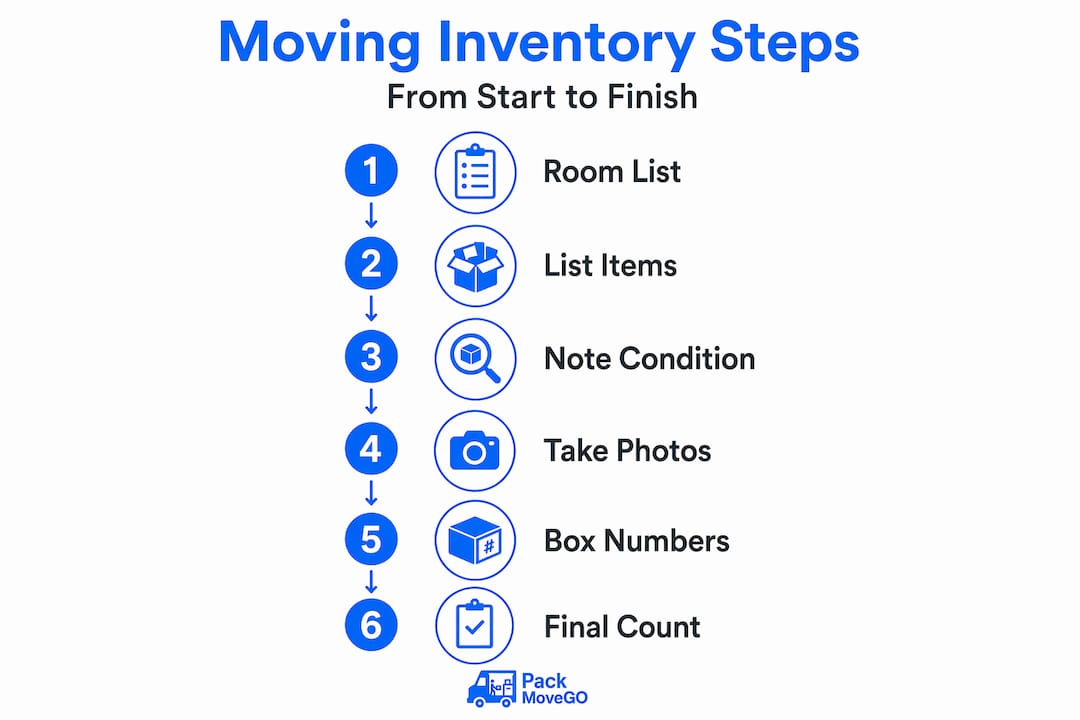
Step 2: Go room by room and list every item being moved. Be specific. Note condition for anything with existing wear.
Step 3: Photograph each item before packing. Capture serial numbers for electronics and appliances.

Step 4: Assign box numbers as you pack. Log which items go into which box in your master inventory.
Step 5: Label every box with its number and destination room. Seal and photograph each completed box.
Step 6: Conduct a final count before the truck loads and again after it arrives at the destination.
| Move type | Priority areas | Recommended tools |
|---|---|---|
| Studio or small apartment | Room-by-room photos, basic spreadsheet | Google Sheets, phone camera |
| Large household | Box numbering system, app-based tracking | Inventory app, QR labels |
| Commercial office move | Asset tagging, department assignment logs | Barcode system, asset management software |
| Long-distance move | Full video walkthrough, signed mover inventory | Cloud storage, AI virtual survey |
For businesses, managing moving inventory at the commercial scale means tracking assets by department, assigning responsibility to team members, and reconciling counts at the destination. Proactive inventory management in commercial moves reduces both financial loss and operational downtime.
My take on moving inventory: the part most guides skip
I have reviewed a lot of moving situations, and the pattern is consistent. The people who end up frustrated, undercompensated for damage, or genuinely confused about where their belongings are all share one thing in common. They treated inventory as paperwork instead of protection.
What I have found is that the detail level matters far less than the timing. A simple photo taken before a mover touches an item is worth more than a beautifully formatted spreadsheet created after the truck leaves. The pre-move moment is the one you cannot reconstruct.
I also think most guides oversell the complexity. You do not need a barcode gun or a fancy app to protect yourself. A phone, a cloud folder, and a consistent habit of photographing before you pack will cover 90% of the legal and organizational ground you need. The technology is genuinely useful, but it amplifies good habits. It does not replace them.
The one thing I wish more people understood: digital descriptive inventories let move crews document at the item level without slowing down the operation. That balance between detail and speed is solvable. The tools exist. The question is just whether you use them before something goes wrong or after.
— Support
How Packmovego helps you manage your move with confidence
Packmovego was built around the idea that a move should be transparent from the first item logged to the last box unpacked. When you work with Packmovego, you get licensed and insured professionals who treat documentation as part of the service, not an afterthought. Every residential, commercial, and long-distance move we handle includes clear communication around item condition, loading verification, and damage accountability.
If you are ready to experience a move where nothing disappears into a gap between checklists, explore Packmovego's moving services to find the right option for your home or business. From free quotes to 24/7 support, every step is designed to give you control and clarity. Your belongings deserve more than a casual list. Let Packmovego show you what professional inventory management for moving actually looks like in practice.
FAQ
What is a moving inventory?
A moving inventory is a detailed, item-level record of everything being relocated, including descriptions, condition notes, photos, and box assignments. It goes well beyond a basic checklist to serve as documentation for tracking, insurance, and accountability.
Why does inventory management matter for my move?
Inventory management protects you legally and financially. Because the burden of proof in damage claims rests with you, pre-move documentation with dates and photos is your strongest evidence if something gets damaged or lost in transit.
What tools work best for tracking a moving inventory?
Spreadsheets, mobile inventory apps, QR code labels, and AI-powered virtual surveys are all effective options. The right tool depends on your move size. A small household does well with a phone camera and a Google Sheet, while large commercial moves benefit from barcode scanning and asset management software.
When should I start my moving inventory?
Start before you pack a single box. Starting early and updating continuously throughout the packing process reduces errors, prevents missing items, and gives you a complete record before any mover touches your belongings.
Do I need a separate inventory for items going into storage?
Yes. Any item going into storage should be logged separately with its own condition notes and photos. This protects you during the storage period and makes the transition from storage back to your home or office far easier to manage.