

Most people assume professional packing means someone comes to your home, throws your things into boxes, and sends you on your way. That assumption costs people thousands of dollars in damaged belongings every year. Professional packing is a structured, skill-based process that protects your items through careful inventory, specialized materials, and proven techniques. Whether you are a homeowner relocating across California or a small business moving sensitive equipment to a new office, understanding what professional packing actually involves can change the outcome of your entire move.
Table of Contents
- Understanding professional packing
- Core services included in professional packing
- When does professional packing make sense?
- How to choose a professional packing service
- Our perspective: What most people misunderstand about professional packing
- Explore seamless packing solutions with PackMoveGo
- Frequently asked questions
Key Takeaways
| Point | Details |
|---|---|
| Comprehensive process | Professional packing goes beyond boxing up items and includes careful planning, safe wrapping, and detailed labeling. |
| Valuable for complex moves | Homeowners and businesses benefit most when safeguarding valuable, fragile, or numerous items. |
| Helps reduce stress | Outsourcing packing to experts saves time and minimizes risk during your California relocation. |
| Choose wisely | Evaluating providers carefully ensures you get trustworthy, quality service tailored to your moving needs. |
Understanding professional packing
Professional packing is not simply the act of placing items in boxes. It is a disciplined process carried out by trained specialists who understand how materials behave during transit, how to prevent shifting, and how to protect items of every shape, size, and fragility level. This distinction matters because most moving damage occurs during transport, not handling, and improper packing is the leading cause.
Homeowners, renters, and businesses all use professional packing for different reasons. A family moving from San Francisco to San Diego might hire professionals to protect antique furniture and fragile dishware. A small business relocating its office might need professionals to handle server equipment, monitors, and filing systems without interrupting operations. Specialty item owners, such as those with fine art collections, wine cellars, or musical instruments, rely on professional packers because the cost of a mistake is simply too high.
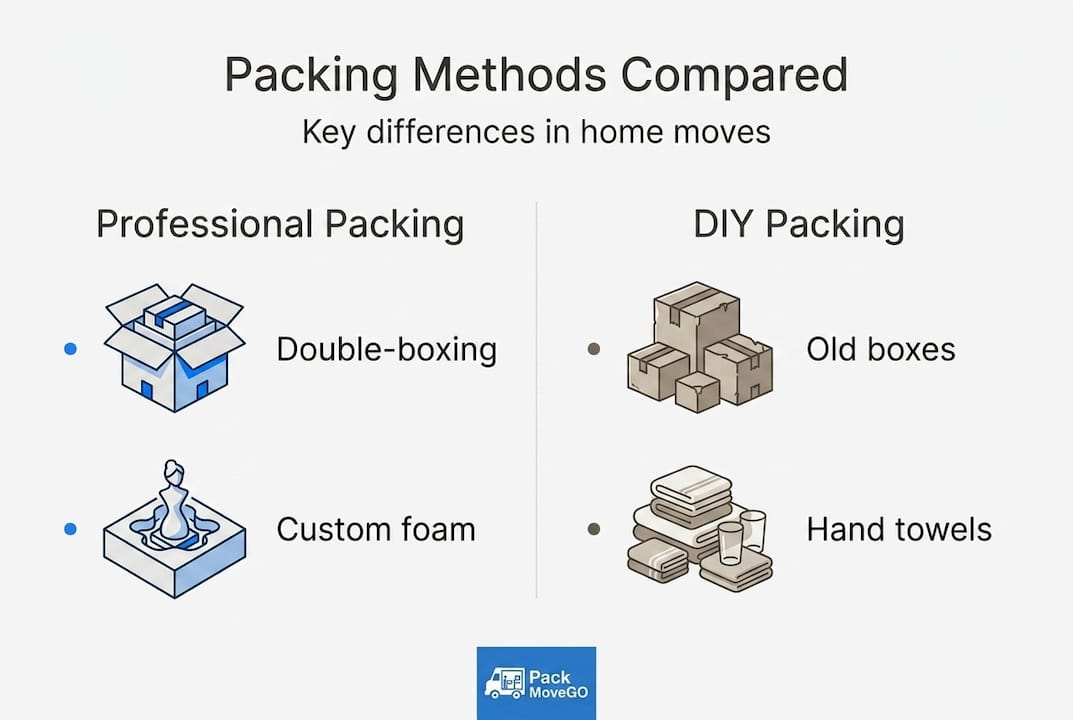
Here is how professional packing compares to DIY packing:
| Factor | Professional packing | DIY packing |
|---|---|---|
| Materials | Industry-grade boxes, custom wraps | Household supplies, recycled boxes |
| Speed | Fast, systematic, team-based | Slower, often scattered |
| Accountability | Licensed, insured, documented | No recourse for damage |
| Organization | Labeled by room, weight, fragility | Often inconsistent |
| Specialty items | Trained handling protocols | Risk of improper wrapping |
| Stress level | Low for the homeowner | High, especially near move day |
The core differences come down to system, expertise, and accountability. Professional packers arrive with a plan. They assess your home or office first, prioritize items by fragility and size, and work through each room methodically. DIY packing tends to happen in bursts, often rushed, and rarely follows a consistent labeling or stacking logic.
Common scenarios where professional packing makes a clear difference include:
- Long-distance moves across California where items spend more time in transit
- Office relocations where downtime must be minimized
- Moves involving specialty items like artwork, pianos, or electronics
- Households with young children or elderly members where time is limited
- Situations where the homeowner has a disability or physical limitation
Pro Tip: When professionals handle fragile items, they use double-boxing for electronics, custom-cut foam inserts for valuables, and corner protectors for framed art. Ask your packing team to walk you through their wrapping process for high-value items before they start. This simple step sets expectations and prevents surprises.
Our professional packing services are built around these exact principles, ensuring every item in your home or business gets the level of care it actually needs.
Core services included in professional packing
Having clarified what professional packing means, let us explore exactly what services are typically included. Most people expect boxes and tape. What they actually receive is a complete logistical system that handles their belongings from start to finish.
The process typically follows this sequence:
- Initial inventory and assessment. Packers walk through your space and document every item that needs to be packed. This step creates a record that protects both you and the moving company.
- Material selection and supply. Based on the inventory, the team selects appropriate boxes, padding, wrapping materials, and specialty containers. You do not need to source these yourself.
- Wrapping and protection. Each item is wrapped according to its specific needs. Dishes get cell-divided boxes. Mirrors get mirror cartons. Electronics get anti-static wrap and custom foam.
- Packing and sealing. Items are loaded into boxes with appropriate cushioning and sealed securely. Weight distribution within each box is factored in to prevent crushing.
- Labeling and organization. Every box is labeled by room, content type, and handling instruction. Fragile labels, orientation arrows, and weight indicators are standard practice.
- Unpacking and reassembly (optional). Many professional services offer unpacking at the destination, placing items in designated rooms and reassembling furniture as needed.
Here is a breakdown of specialized handling by item type:
| Item type | Packing method | Material used |
|---|---|---|
| Fragile dishware | Cell-divided boxes, vertical stacking | Packing paper, foam dividers |
| Electronics | Anti-static wrap, original or custom box | Foam inserts, sealed bags |
| Artwork and mirrors | Mirror cartons, flat stacking | Corner protectors, glassine paper |
| Clothing | Wardrobe boxes, hanging intact | No folding required |
| Books and files | Small, heavy-rated boxes | Acid-free paper for documents |
| Furniture | Blanket wrapping, disassembly if needed | Moving blankets, stretch wrap |
The packing tips for your move section of our resource library covers these methods in more detail, particularly for items that are often overlooked, like lamps, plants, and small appliances.
One area many clients overlook is document management during commercial moves. Professional packers working in business environments often use numbered filing systems so that office records stay organized and accessible right after the move.
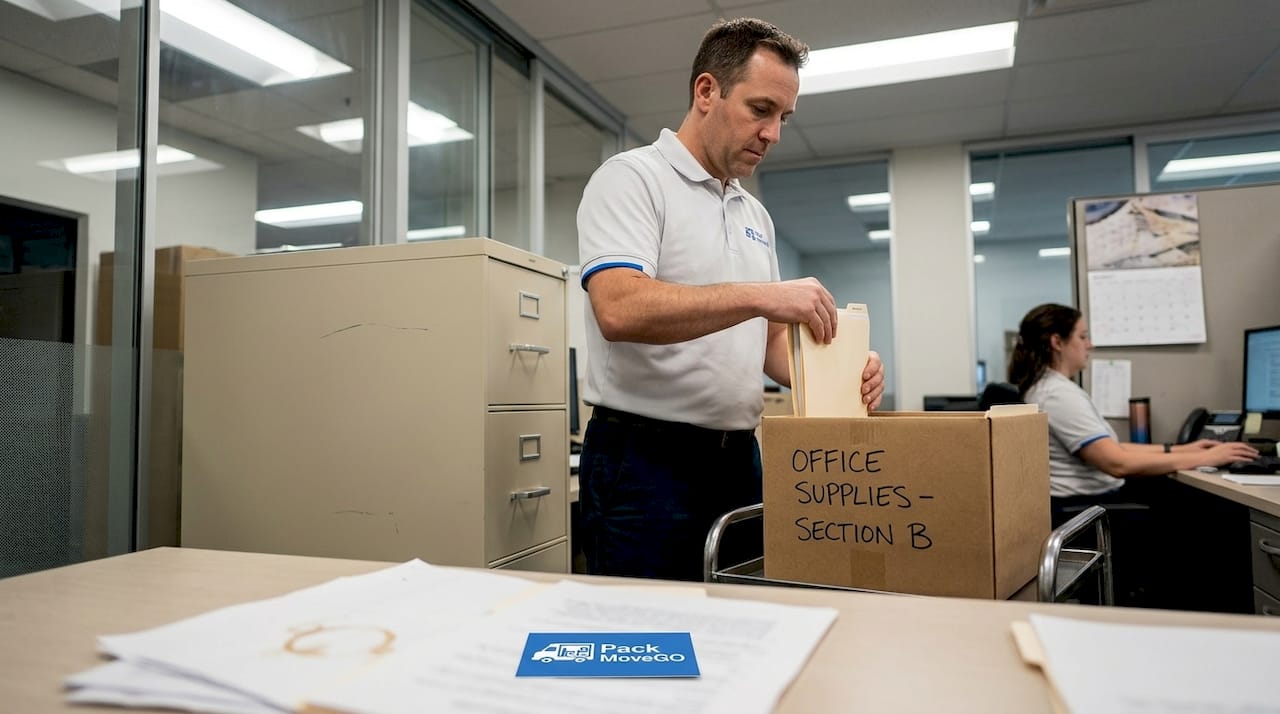
Pro Tip: Ask your packing provider whether they use industry-standard packing methods for electronics specifically. Static discharge during packing is a real risk that cheaper services often ignore. Anti-static bags are not expensive, but they make a significant difference for computers and hard drives.
When does professional packing make sense?
After understanding the services professional packing includes, let us identify when it is the right choice for your upcoming move. The answer is not always obvious, and it depends on your specific situation, budget, and what you are moving.
Professional packing makes the most financial sense in the following situations:
- You have high-value or irreplaceable items that cannot be replaced if damaged
- You are moving long-distance, where items face more vibration, temperature shifts, and transit time
- Your schedule is tight and you cannot dedicate a week or more to packing your home
- You are running a business and cannot afford employee downtime during a relocation
- You have already experienced a damaging DIY move and want to avoid a repeat
Time savings alone can justify the cost for many California families. A professional team of three can pack an average three-bedroom home in one full day. The same job done by a family on weekends often takes two to three weeks, with significant stress along the way.
Consider this: a small tech startup in Los Angeles recently relocated its team of 12 to a larger office in Burbank. They had 40 workstations, two server racks, and a conference room full of AV equipment. By hiring a professional packing team, they completed the move over a single weekend and were fully operational by Monday morning. A DIY approach would have meant significant IT risk and days of lost productivity.
"For businesses, a move that causes even two days of downtime can cost more than an entire professional packing service. The math usually favors the professionals." This holds true whether you are a solo contractor moving your home office or a regional company relocating an entire floor.
California presents specific considerations that make professional packing even more relevant. The state is large, meaning local moves can still involve hundreds of miles. Wildfire risk during summer and fall means some moves require faster timelines than planned. Certain California counties also have specific regulations about moving truck sizes and operating hours that professional movers already know how to navigate.
The role of professional moving services in managing these logistics goes beyond packing. A good provider coordinates packing with transportation and delivery to reduce your exposure to all of these variables.
For fragile and specialty items, the cost-benefit calculation is straightforward. Replacing a broken 60-inch television costs several hundred to over a thousand dollars. Professional packing for that single item adds a modest amount to your total moving cost. The math strongly favors protection.
How to choose a professional packing service
Once you have decided professional packing might be right, here is how to confidently select the best team for your move. California has a large moving industry, and quality varies significantly between providers.
Follow these steps when evaluating any packing service:
- Verify licensing and insurance. In California, movers must be licensed with the California Public Utilities Commission (CPUC). Ask for the company's CAL-T number and confirm it is active. Insurance coverage protects your belongings if something goes wrong.
- Review their service range. Not all movers offer full packing services. Confirm they handle your specific needs, whether that is specialty items, commercial equipment, or full home packing.
- Check reviews and references. Look at reviews on Google, Yelp, and the Better Business Bureau. Pay attention to how the company responds to negative feedback, not just how many five-star ratings they have.
- Request a written estimate. Any reputable provider will offer an itemized estimate in writing. Verbal quotes are not binding and can lead to surprise charges on move day.
- Ask about their packing team. Find out whether the people doing the packing are employees or subcontractors. Employees are typically held to higher quality standards and are covered by the company's insurance.
- Confirm material quality. Ask what type of boxes and wrapping materials they use. Industry-grade materials are significantly stronger than retail options.
Watch for these red flags when choosing a provider:
- No physical address or verifiable business presence
- Unusually low estimates that seem too good to be true
- Pressure to sign a contract before an in-home assessment
- Reluctance to provide proof of licensing or insurance
- Payment demanded entirely upfront before services are rendered
California-specific considerations include checking whether the provider has experience with your destination city's regulations, especially for long-distance moves between Northern and Southern California. Providers who serve the full state have a clear advantage over those who only operate locally.
Our packing and moving experts are licensed, insured, and familiar with California's specific requirements. We offer written estimates before any work begins, so you know exactly what to expect.
Pro Tip: Before signing any contract, ask for a line-item breakdown of your estimate. This shows you the cost per service and makes it easy to compare quotes from multiple providers. A company that refuses to itemize is a company that may charge hidden fees. Also, review the available packing solutions your provider offers to ensure they match your actual needs, not a generic package.
Our perspective: What most people misunderstand about professional packing
Most people treat packing as a last-minute task. They spend weeks decluttering and organizing, then panic-pack everything in the final 48 hours before the movers arrive. That pattern is where most damage and stress originates.
What we have learned from years of serving California moves is that packing is actually the most strategic part of any relocation. When packing is planned early and executed professionally, everything else works better. Boxes arrive labeled correctly, movers can unload faster, and unpacking at the new location takes hours instead of days.
There is also a financial misunderstanding that runs deep. Many homeowners assume professional packing is a luxury for wealthy people. In reality, a single broken appliance or damaged piece of furniture can cost more than an entire packing service. The risk calculation is rarely done honestly, because people underestimate what their belongings are actually worth.
Our expert moving tips challenge the idea that saving money on packing is smart. In most cases, the opposite is true. Investing in professional packing early is one of the most practical decisions you can make for a smooth, low-stress move.
Explore seamless packing solutions with PackMoveGo
If this guide has helped you see professional packing differently, the next step is straightforward.
PackMoveGo offers professional packing and moving services across California, designed for homeowners and businesses who need reliable, damage-free relocations. Our licensed and insured team brings the materials, the process, and the experience directly to your door. You can also browse our library of moving tips and tricks to prepare for your move before we arrive. Whether you are planning a local move or a long-distance relocation within the state, the PackMoveGo home page gives you access to free quotes and direct support. Let us handle the packing so you can focus on everything else.
Frequently asked questions
What does a professional packer actually do?
Professional packers inventory, organize, and securely wrap your belongings using industry-grade materials and proven techniques to ensure everything arrives safely at your new location.
Is professional packing worth the cost for a small business move?
For small businesses, professional packing prevents equipment damage and operational downtime, which typically costs far more than the packing service itself.
How far in advance should I schedule professional packing for a move?
It is best to schedule packing two to four weeks before your move date to ensure team availability and allow time for a thorough pre-move assessment of your items.
Are packing materials included in professional packing services?
Yes, professional packing services include high-quality, purpose-selected materials such as reinforced boxes, foam inserts, anti-static wrap, and specialty cartons tailored to your specific items.