

Most people assume hiring movers means someone drives a truck from point A to point B. That's it. But full service moving covers far more ground than simple transportation, and for homeowners and renters across California, understanding the difference can change your entire experience. From professional packing to furniture reassembly, a true full service move handles nearly every physical task involved in relocating. This article breaks down exactly what full service moving includes, when it makes sense for your situation, what the process looks like from start to finish, and how to protect yourself with the right mover in California.
Table of Contents
- What full service moving really means
- Key benefits and when full service moving is worth it
- The full service moving process step-by-step
- Costs, California regulations, and choosing the right mover
- Our take: What most movers won't tell you about full service
- Get started with stress-free California moving
- Frequently asked questions
Key Takeaways
| Point | Details |
|---|---|
| Full service covers everything | Full service moving includes packing, loading, transport, unpacking, and more—all handled by professionals. |
| Ideal for complex moves | Full service is best for busy, large, or complicated moves where saving time and reducing risk is essential. |
| Still requires preparation | Clients need to prep no-pack zones, clarify items, and check access to ensure smooth moving day. |
| Compare costs and licenses | Always get multiple estimates and choose a licensed California mover to protect your move and your belongings. |
What full service moving really means
With a clearer view of what moving companies can offer, let's break down what full service moving actually covers.
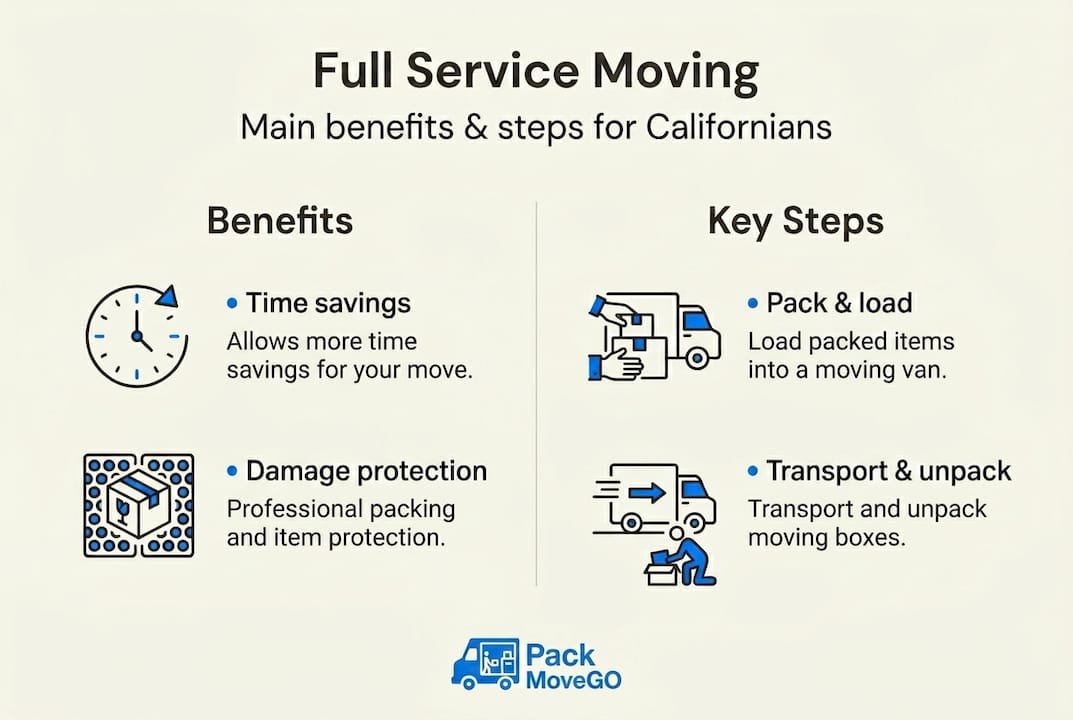
Full service moving is a type of relocation package where the moving company handles every major physical task. You are not just hiring someone to transport boxes. You are hiring a team to manage the entire process, from wrapping your furniture to placing it in your new living room.
According to industry standards, full-service covers packing, transport, loading, unloading, and even furniture reassembly. That is a significant difference from self-service or labor-only options, where you do most of the work yourself and only pay for truck access or muscle power.
Here is what a standard full service package typically includes:
- Professional packing of all household items using proper materials
- Furniture disassembly before the move
- Loading everything onto the moving truck
- Transportation to your new address
- Unloading at your destination
- Unpacking boxes in designated rooms
- Furniture reassembly
- Removal of packing debris
Compare that to your other options:
| Move type | Who packs | Who loads | Who drives | Who unpacks |
|---|---|---|---|---|
| Full service | Movers | Movers | Movers | Movers |
| Self-service | You | You | Movers | You |
| DIY | You | You | You | You |
For homeowners with large amounts of furniture or renters in multi-story buildings, the difference is not just convenience. It is protection. Professional movers know how to wrap fragile items, navigate tight staircases, and load trucks efficiently to prevent shifting during transport.
Pro Tip: Professional packing reduces damage risk significantly because movers use industry-grade materials and proven techniques. If you pack yourself, even one improperly wrapped item can mean a broken lamp or a scratched dresser. When you explore your moving service options, ask specifically what is covered under the packing portion of any package.
Key benefits and when full service moving is worth it
Understanding what full service moving offers lets you weigh its true advantages, especially for California moves.
The most common reason people choose full service moving is time. Packing a three-bedroom home can take 40 to 60 hours when you do it yourself. That does not include disassembly, loading, or cleanup. For working professionals, parents, or anyone managing a busy schedule, that time simply is not available.

Full service moving saves significant time and stress, reduces damage risk, and is best for large, complex, or time-sensitive moves. That is not just a sales pitch. It reflects the practical reality of what moving actually demands.
Here are four situations where full service moving makes clear sense:
- Large homes with lots of furniture and fragile items where DIY packing creates real damage risk.
- Busy professionals or families who cannot take multiple days off work to pack and prepare.
- Moves involving access challenges like apartment buildings with elevators, narrow hallways, or stairs.
- Long-distance California moves where driving a rental truck across the state adds stress and cost.
"The value of full service moving is not just in the labor. It is in the expertise, the accountability, and the time you get back to focus on settling into your new home rather than surviving the move itself."
For context on pricing, full service moves in California typically range from $1,000 to $4,500 for local moves, with long-distance moves running higher depending on volume and distance. Understanding the factors affecting moving costs helps you budget realistically before you commit.
That said, not every move needs full service. If you are moving a studio apartment across town with minimal furniture, a self-service or labor-only option may serve you just as well at a lower cost. The key is matching the service level to the actual complexity of your move.
The full service moving process step-by-step
Once you decide on full service, here is what the moving process actually looks like.
Knowing the stages in advance removes a lot of anxiety. Here is a typical timeline for a residential full service move:
- Initial estimate (1 to 2 weeks before booking): A mover visits or conducts a virtual walkthrough to assess volume and provide a written quote.
- Booking and confirmation (at least 2 to 4 weeks before move day): You confirm dates, sign a contract, and review what is included.
- Packing day (1 to 2 days before move day or same day): The crew arrives with materials and packs your entire home.
- Loading (move day): Furniture is disassembled, wrapped, and loaded onto the truck.
- Transport: Your belongings travel to the new address. For local moves, this is same day.
- Unloading and placement: Movers bring items inside and place them in the rooms you specify.
- Unpacking and reassembly: Boxes are opened, furniture is put back together, and debris is removed.
| Stage | Movers handle | You handle |
|---|---|---|
| Estimate | Assessment and quote | Provide access and information |
| Packing | All materials and labor | Set aside no-pack zones |
| Loading | All furniture and boxes | Confirm item list |
| Transport | Driving and logistics | Be available by phone |
| Unloading | Placement in rooms | Direct where things go |
| Unpacking | Open boxes, reassemble | Inspect and confirm |
Even full-service moves require customer prep like no-pack zones and checking access. Your job is to set aside valuables, medications, important documents, and anything you want to transport personally. Label those areas clearly so movers know not to touch them.
For solid pre-move planning tips, walk through your home before packing day and do a room-by-room inventory. Communicate any access restrictions at either address to your mover in advance.
Pro Tip: The single fastest way to speed up move day is to have a clear floor plan of your new home ready. When movers know exactly where each piece of furniture goes, placement takes minutes instead of hours.
Costs, California regulations, and choosing the right mover
Every move comes with a price tag and some important legal protections you should not overlook.
In California, full service moving costs vary based on home size, distance, the number of specialty items like pianos or antiques, and whether you need storage. A one-bedroom local move might run $800 to $1,500. A four-bedroom long-distance move can exceed $8,000. Always get a written estimate so you know exactly what you are paying for.
California has specific consumer protections for movers. Here is what you need to know:
- All movers operating in California must hold a BHGS license and a Cal-T number issued by the California Public Utilities Commission.
- Movers are required to provide a written estimate before any work begins.
- You have the right to a binding or non-binding estimate in writing.
- Insurance options include basic coverage (typically $0.60 per pound per item) or full-value protection, which covers repair or replacement at current market value.
- Movers cannot hold your belongings hostage for payment above the written estimate.
Choose BHGS-licensed movers with a valid Cal-T number, get three written estimates, and clarify insurance coverage before signing anything. This protects you from the most common moving scams and disputes.
Red flags to watch for include companies that only give verbal quotes, demand large cash deposits upfront, or cannot provide a Cal-T number when asked. Check reviews on Google and Yelp, and ask for references from recent local moves.
When reviewing licensed moving services, confirm that insurance terms are spelled out in your contract. Full-value protection costs more but gives you real coverage if something breaks.
Pro Tip: Always get at least three written estimates from different companies. Price alone should not decide your choice. Look at what each estimate includes, how the company handles claims, and whether they have verifiable reviews.
Our take: What most movers won't tell you about full service
After covering the basics, here is what our experience reveals about the promises and realities of full service moving.
The phrase "stress-free move" gets used a lot. The honest version is that full service moving dramatically reduces stress, but it does not eliminate your involvement entirely. The moves that go smoothly are almost always the ones where the client stayed engaged.
No-pack zones, clear labeling, and direct communication with your crew prevent the vast majority of problems. We have seen moves where clients assumed everything would be handled automatically, only to find that sentimental items were packed or access was blocked at the new address. Those are not mover failures. They are communication gaps.
Not all "full service" packages are equal either. Some companies use that label while excluding unpacking or debris removal. Always read the contract line by line. The real-world moving lessons that matter most are the ones about preparation, not just price.
Full service moving is genuinely worth it for the right move. But the best results come when you treat it as a partnership, not a hands-off transaction.
Get started with stress-free California moving
Ready to make your California move as stress-free as possible?
PackMoveGo connects California homeowners and renters with licensed, insured moving professionals who handle every step of the process. Whether you need a full packing service or just want a reliable crew for move day, you can explore full service moving solutions and get a free quote without any obligation.
Not sure where to start? The professional moving help available through PackMoveGo includes support from initial planning through final placement. You can also browse moving tips to prepare before your first call. The right move starts with the right information, and we are here to provide both.
Frequently asked questions
Does full service moving include packing and unpacking?
Yes, full service moving typically involves both professional packing at your old residence and unpacking at your new home. Full-service covers packing and unpacking among other moving tasks, though you should confirm what is included in your specific contract.
How much does a full service move cost in California?
Most full service moves in California fall within a cost range of $1,000 to $4,500, depending on move distance, total volume, and any specialty items that require extra care.
How do I verify if a moving company is licensed in California?
Always choose BHGS-licensed movers and verify their Cal-T number. You can confirm this directly with the California Public Utilities Commission through their online database.
Am I still responsible for anything if I hire full service movers?
Yes, you should set aside no-pack zones for valuables and essentials, clarify what stays or goes, and ensure access for movers at both locations. Even with full service, customers need to prep certain items and locations for the move to go smoothly.
Recommended
- PackMoveGo - Professional Moving & Packing Services
- Moving Tips & Advice - PackMoveGo Blog
- Our Services - PackMoveGo | Residential, Commercial & Long Distance Moving
- Full-service moving explained: stress-free packing to delivery
- What Do Professional Movers Do? | Aleks Moving